

Mastering AI Product Timelines: From Concept to Completion
Unlock the secrets of AI product development! Explore essential phases, realistic timelines, and strategies for success in your projects."
How Long Does It Really Take to Build an AI Product?
Developing an AI product is a complex and multifaceted endeavor that requires careful planning, execution, and monitoring. For leaders and operators in traditional companies exploring AI adoption, understanding the phases of AI product development and realistic timelines is crucial. This guide breaks down the AI product development lifecycle, provides insights into accelerating timelines, and offers actionable strategies to help you navigate this intricate process effectively. Jaxxon Technology Services, as an AI-first technology consulting studio, is committed to transforming AI from hype into measurable business value for organizations.
Understanding the Phases of AI Product Development
The development of an AI product typically follows a structured lifecycle that ensures effective management and timely delivery. The key phases include:
Problem Definition
The first step in AI product development is clearly articulating the business problem and the objectives of the AI solution. This phase sets the foundation for all subsequent activities and involves stakeholders to ensure alignment with business goals. By clearly defining the problem, teams can avoid scope creep and focus on delivering value.
Deeper Explanation: Importance of Stakeholder Involvement
Involving stakeholders early ensures that the AI initiative aligns with strategic objectives and addresses actual business needs. Stakeholders can provide insights into operational challenges and potential impact areas, leading to more targeted and effective solutions.
Data Acquisition and Preparation
Data is the lifeblood of AI. This phase involves gathering relevant datasets, cleaning, and preparing them for analysis. It is often time-consuming but critical, as the quality of data directly impacts the performance of the AI model. Investing time and resources in this phase ensures that the AI solution is built on a solid foundation.
Real-World Example: Data Preparation in Retail
Consider a retail company aiming to implement an AI-driven recommendation system. Data preparation might involve aggregating customer purchase histories, preferences, and browsing behaviors from disparate systems. Cleaning this data involves resolving inconsistencies and ensuring accuracy, which is crucial for effective recommendations.
Model Development and Training
In this phase, AI models are created and refined. It involves selecting appropriate algorithms, training models on the prepared data, and iteratively improving them based on performance metrics. This process requires expertise and time, as models need to be fine-tuned to achieve the desired accuracy and reliability.
Advanced Tip: Choosing the Right Algorithm
Selecting the right algorithm is critical. Decision trees, neural networks, and support vector machines each have strengths and weaknesses. Understanding the problem's nature and data structure can guide this choice, ensuring a balanced approach between complexity and performance.
Model Evaluation and Refinement
Once a model is developed, it must be evaluated against unseen data to assess its effectiveness. This phase involves making necessary adjustments to enhance performance and ensure that the model meets business objectives. Effective evaluation is crucial to avoid deploying ineffective models that could lead to poor business outcomes.
Common Pitfall: Overfitting
Overfitting occurs when a model performs well on training data but poorly on new data. It's essential to use techniques like cross-validation and regularization to prevent this, ensuring that the model generalizes well to unseen data.
Deployment and Monitoring
After a model passes evaluation, it is deployed into production. Continuous monitoring is essential to ensure that the AI product performs as expected and adapts to real-world feedback. This phase involves setting up systems to track performance metrics and make ongoing adjustments to maintain efficacy.
Actionable Step: Setting Up a Monitoring Framework
Implement a robust monitoring framework to track model performance post-deployment. Tools like Prometheus or Grafana can help visualize key metrics, enabling proactive adjustments.
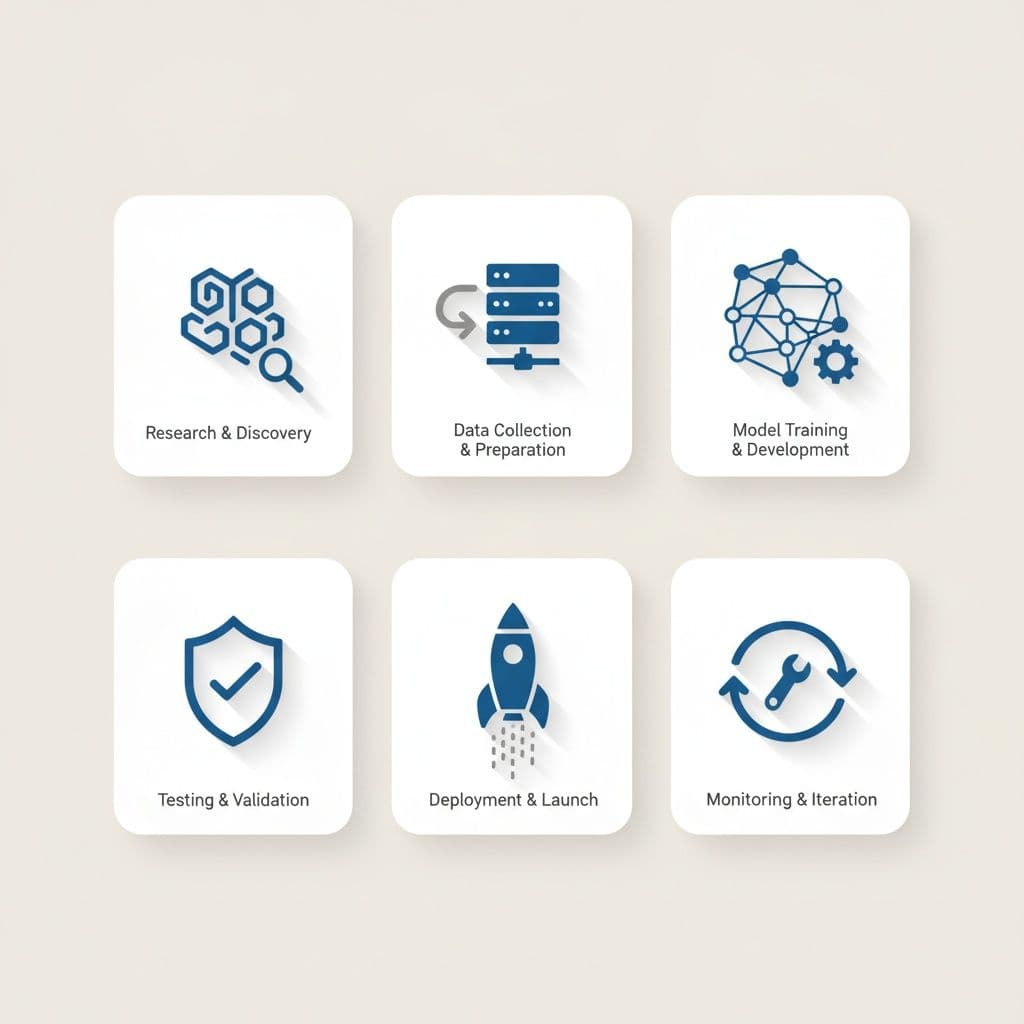
Visual representation of the AI product development phases
What Are Realistic Timelines for AI Initiatives?
Realistic timelines for AI product development can vary significantly based on factors such as project complexity, data availability, and organizational readiness. However, understanding typical timelines for each phase can help set achievable expectations:
- Problem Definition: 2-4 weeks
- Data Acquisition and Preparation: 4-8 weeks
- Model Development and Training: 6-12 weeks
- Model Evaluation and Refinement: 4-6 weeks
- Deployment and Monitoring: Ongoing
These timelines are rough estimates and can differ based on specific project needs and resource availability. It's important to maintain flexibility and adapt timelines as projects progress.
How Can You Accelerate AI Product Timelines?
Accelerating AI product development timelines involves strategic planning and leveraging technology effectively. Here are actionable strategies to speed up the process:
Leverage AI-Driven Automation
AI-driven automation can optimize repetitive tasks, freeing up human resources for complex problem-solving. Automating data preparation and model training processes can significantly reduce development time.
Adopt Agile Methodologies
Integrating agile methodologies with AI development facilitates faster iterations and feedback loops. Agile practices help teams adapt quickly to changing requirements and improve collaboration across cross-functional teams.
Real-World Example: Agile in AI Development
A financial services firm utilized agile methodologies to develop a fraud detection system. By employing sprints and regular feedback sessions, the team quickly iterated on the model, incorporating stakeholder feedback and market changes in real-time.
Utilize Pre-Trained Models
Using pre-trained models can expedite the model development phase. These models, available through AI platforms, provide a solid starting point and can be fine-tuned to meet specific business needs, saving valuable time.
Comparison: Custom Models vs. Pre-Trained Models
Custom models offer flexibility and specificity but require more time and expertise. Pre-trained models offer a quicker start but might need adjustments to fit unique business requirements. Evaluate based on project goals and available resources.
Foster a Collaborative Environment
Creating a collaborative environment encourages knowledge sharing and innovation. Cross-functional teams with diverse expertise can work together more effectively, leading to faster problem-solving and timeline reductions.
Actionable Step: Establishing Cross-Functional Teams
Form cross-functional teams comprising data scientists, domain experts, and IT professionals. Regular workshops and collaboration tools like Slack or Microsoft Teams can facilitate communication and innovation.

Illustration of agile methodologies applied to AI development
The Role of AI in Enhancing Product Development
AI technologies are revolutionizing product development by enhancing efficiency and innovation. By integrating AI into the development process, organizations can achieve:
Faster Execution
AI tools can process vast amounts of data quickly, accelerating the ideation and prototyping phases. This rapid processing allows teams to move from concept to market-ready products in significantly less time.
Reduced Uncertainty
Predictive analytics powered by AI helps in making informed decisions based on market trends. This reduces uncertainty and aligns product features with customer needs, improving the chances of product success.
Stronger Decision-Making
AI-driven analytics provide actionable insights, enabling teams to identify market opportunities and optimize product designs. This leads to more strategic decision-making and better alignment with business objectives.
Improved Operations
AI can streamline operations by automating routine tasks and enhancing resource allocation. This efficiency allows teams to focus on value-added activities, ultimately improving overall productivity.

Diagram illustrating the role of AI in enhancing product development
Embracing AI: A Strategic Approach
To effectively integrate AI into product development, organizations must adopt a strategic approach:
Align with Business Objectives
AI initiatives should be closely aligned with business objectives to ensure they deliver measurable value. Setting clear goals and regularly assessing progress against these objectives is essential.
Set Achievable Milestones
Breaking down AI projects into smaller milestones allows for incremental improvements and timely adjustments. This phased approach helps manage risks and keeps projects on track.
Visual Description: Milestone Planning
Imagine a Gantt chart where each milestone is a checkpoint on the timeline. This visual tool helps teams monitor progress and adjust efforts to meet deadlines.
Invest in Training and Resources
Ensuring that teams are adequately trained to leverage AI technologies is crucial. Investing in resources and upskilling employees enhances their ability to utilize AI effectively and maximize project outcomes.
Common Pitfalls and Solutions
Pitfall: Underestimating Data Challenges
Many projects falter due to underestimating the complexity of data preparation. Address this by conducting a thorough data audit early and planning for potential challenges.
Solution: Implementing a Data Strategy
Develop a comprehensive data strategy that includes data sourcing, quality checks, and governance. This proactive approach can mitigate risks and set a strong foundation for AI development.
Conclusion
Building an AI product is a journey that requires careful planning, execution, and monitoring. By understanding the phases of AI product development and adopting strategies to accelerate timelines, traditional companies can effectively integrate AI and achieve measurable business value. Jaxxon Technology Services is dedicated to guiding organizations through this process, ensuring faster execution, reduced uncertainty, and improved operations. Embrace AI strategically, and transform potential into tangible outcomes. For more insights on AI product development, connect with our experts today.
FAQs
How can Jaxxon Technology Services assist in AI development?
Jaxxon provides end-to-end consulting services, from strategy formulation to deployment, ensuring that AI initiatives deliver real business value.
What are common challenges when building AI products?
Challenges include data quality issues, integration complexities, and aligning AI outcomes with business goals. Addressing these early with strategic planning helps mitigate risks.
How to choose between pre-trained and custom models?
Evaluate the project's specific needs, available resources, and time constraints. Pre-trained models offer speed, while custom models provide flexibility and specificity.
What role do stakeholders play in AI projects?
Stakeholders provide critical insights and ensure that AI solutions align with business objectives, enhancing the project's relevance and effectiveness.
How does AI improve decision-making?
AI processes large data sets to uncover trends and patterns, providing actionable insights that support informed and strategic business decisions.
Community
Join the conversation
More Blog Posts

Unveiling the Timeline: How Long to Build an AI Product?
Building an AI product is a complex journey filled with challenges. Discover the key stages and insights that can guide you from concept to deployment!

AI Agents: The Next Generation of Business Software Transforming Operations
Discover how AI agents are revolutionizing business operations by transforming software into proactive collaborators that anticipate needs and streamline complex processes autonomously.

AI Agents in Enterprise Workflows: Transforming Business Operations for 2026
Discover how AI agents are revolutionizing enterprise workflows, transforming businesses into proactive, autonomous entities that enhance efficiency and drive measurable value.