

AI Agents: The Next Generation of Business Software Transforming Operations
Discover how AI agents are revolutionizing business operations by transforming software into proactive collaborators that anticipate needs and streamline complex processes autonomously.
AI Agents: Transforming Business Software Operations
Imagine a world where your business software not only responds but anticipates your needs—welcome to the era of AI agents. AI agents represent a fundamental shift from reactive tools to proactive collaborators in business operations. These autonomous systems plan, reason, and act across workflows, transforming traditional software into dynamic partners capable of orchestrating complex processes without constant human intervention.
Unlike chatbots that respond to queries or traditional automation that follows rigid rules, AI agents operate as autonomous systems capable of multi-step reasoning, dynamic adaptation, and intelligent decision-making. They represent a paradigm shift where software moves from being a tool to becoming a true business collaborator.
What Are AI Agents and How Do They Work?
AI agents are autonomous software systems designed to perceive environments, make decisions, and take actions independently. These systems combine artificial intelligence with the ability to interact with multiple software applications, databases, and workflows to complete complex tasks.
AI agents differ fundamentally from traditional software in three key ways:
Autonomous Operation: While traditional software requires explicit user commands for each action, AI agents can initiate tasks, make decisions, and execute multi-step processes independently.
Contextual Understanding: AI agents maintain memory and context across interactions, allowing them to understand the broader business environment and make informed decisions based on historical data and current conditions.
Dynamic Adaptation: Unlike rule-based automation that breaks when conditions change, AI agents can adapt their approach based on new information, unexpected scenarios, and evolving business requirements.
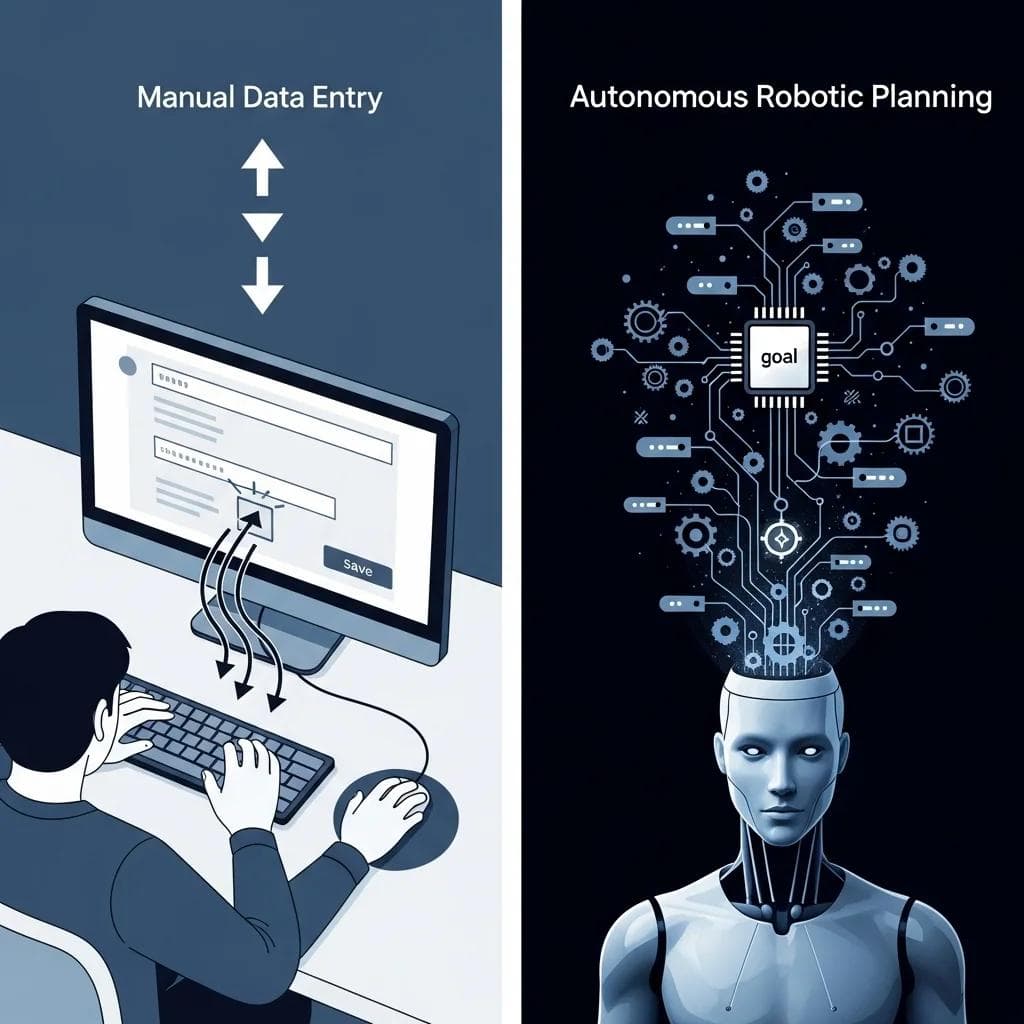
Two contrasting scenes, left side: a person manually inputting data into a computer with arrows leading to a single action, right side: a...
The Core Components of AI Agent Systems
AI agents operate through several integrated components that work together to deliver autonomous functionality:
Planning Engine: This component breaks down complex goals into actionable steps, creating dynamic workflows that can adapt as conditions change. For example, when processing an insurance claim, the agent can plan the entire workflow from initial assessment to final resolution.
Reasoning Module: AI agents use advanced reasoning capabilities to make decisions based on incomplete information, weighing multiple factors and potential outcomes before taking action.
Integration Layer: Unlike standalone applications, AI agents connect with existing business systems, APIs, and databases to access information and execute tasks across multiple platforms seamlessly.
Learning Mechanism: AI agents continuously improve their performance by learning from past interactions, successful outcomes, and feedback loops within the business environment.
How AI Agents Improve Business Workflows
AI agents improve workflows by automating complex processes and adapting to real-time changes. According to industry research, 78% of organizations now employ AI in at least one business function, with AI agents leading the charge in workflow automation.
Multi-Step Process Automation
Traditional automation handles single tasks or simple sequences. AI agents excel at managing complex, multi-step processes that require decision-making at each stage. Consider a healthcare prior authorization process:
- Initial Assessment: The agent reviews the patient's medical history and treatment request
- Policy Verification: It checks insurance coverage and policy requirements
- Documentation Gathering: The agent requests additional information from healthcare providers if needed
- Decision Processing: It evaluates all factors and makes authorization recommendations
- Communication: The agent notifies all relevant parties of the decision and next steps
This entire process, which traditionally required multiple human touchpoints and could take days, can be completed by an AI agent in hours or minutes.
Real-Time Adaptation and Problem Solving
AI agents demonstrate superior workflow improvement through their ability to handle unexpected situations and adapt their approach in real-time. When encountering obstacles or exceptions, they can:
- Identify alternative pathways to achieve the same goal
- Request additional information or clarification when needed
- Escalate complex issues to human supervisors while continuing with other tasks
- Learn from exceptions to handle similar situations more effectively in the future
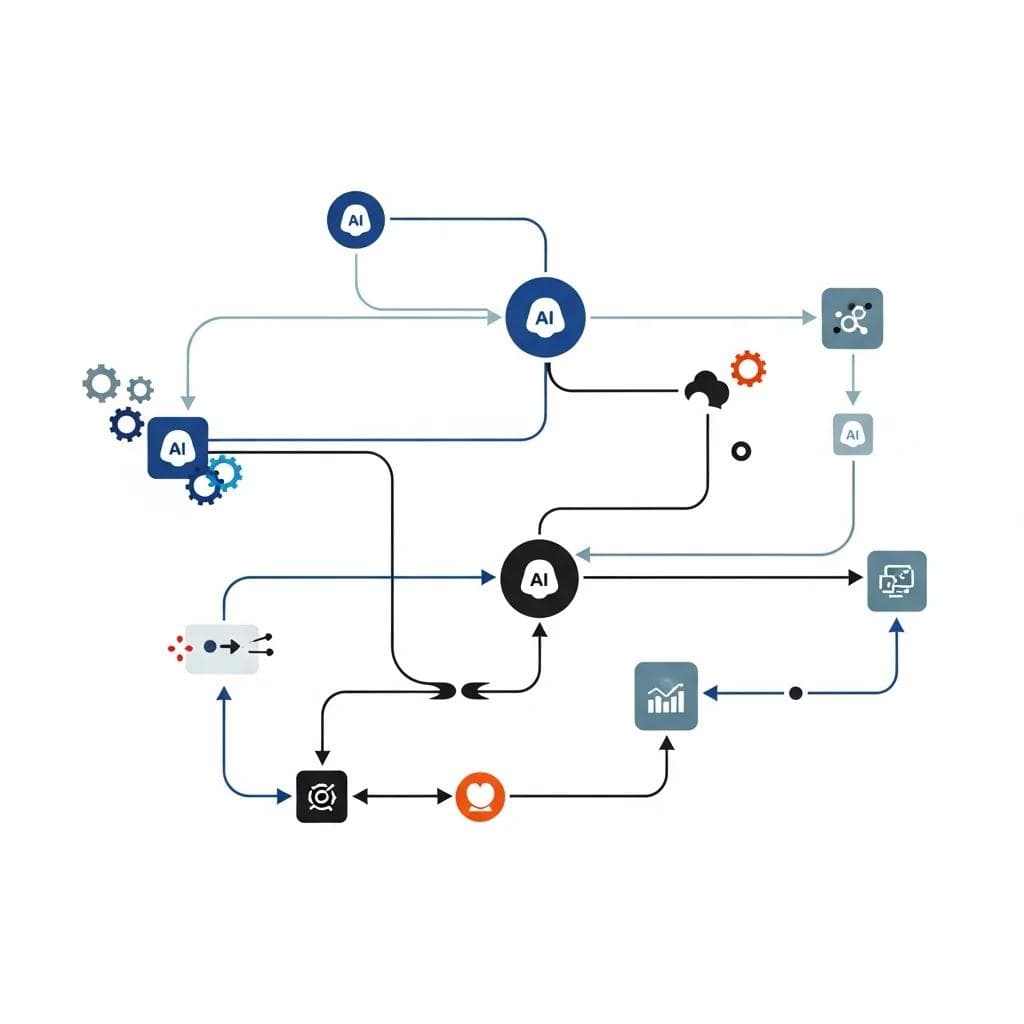
Flowchart with interconnected pathways, branching lines illustrating decision points, nodes AI agents, arrows showing direction of flow,...
Cross-System Integration and Data Synthesis
One of the most powerful aspects of AI agents is their ability to work across multiple business systems simultaneously. They can:
- Pull data from CRM systems, databases, and external APIs
- Synthesize information from disparate sources to create comprehensive insights
- Update multiple systems based on single workflow outcomes
- Maintain data consistency across platforms
For instance, a sales AI agent can monitor lead behavior, update CRM records, trigger marketing automation sequences, and schedule follow-up activities across multiple platforms based on prospect engagement patterns.
Benefits of AI Agents in Business Operations
AI agents offer benefits such as increased efficiency, cost reduction, and enhanced decision-making, fundamentally changing how organizations operate and compete.
Operational Efficiency and Cost Reduction
AI agents typically achieve 80-95% automation rates in targeted processes, leading to significant cost reductions and efficiency improvements. Real-world implementations demonstrate substantial ROI:
- Healthcare Administration: Avi Medical automated 81% of patient inquiries, resulting in a 93% cost reduction and 87% decrease in response time
- Insurance Claims Processing: One provider automated 91% of claims processing, leading to faster resolutions and a 9% increase in customer satisfaction
- Administrative Tasks: Hospital scheduling agents manage appointments 24/7, handling complex requests that previously required human intervention
Enhanced Decision-Making Capabilities
AI agents improve business decision-making by providing:
Data-Driven Insights: Agents continuously analyze business data, identifying patterns and trends that inform strategic decisions.
Predictive Analytics: By processing historical data and current conditions, AI agents can forecast outcomes and recommend proactive measures.
Risk Assessment: Agents evaluate potential risks across multiple scenarios, helping businesses make informed decisions about resource allocation and strategic initiatives.
Scalability and Consistency
Unlike human workers who face capacity constraints, AI agents can:
- Handle increasing workloads without proportional cost increases
- Maintain consistent performance quality regardless of volume
- Operate continuously without breaks or shift changes
- Scale instantly to meet demand spikes
This scalability advantage becomes particularly valuable during peak business periods or rapid growth phases, where traditional staffing approaches would create bottlenecks.
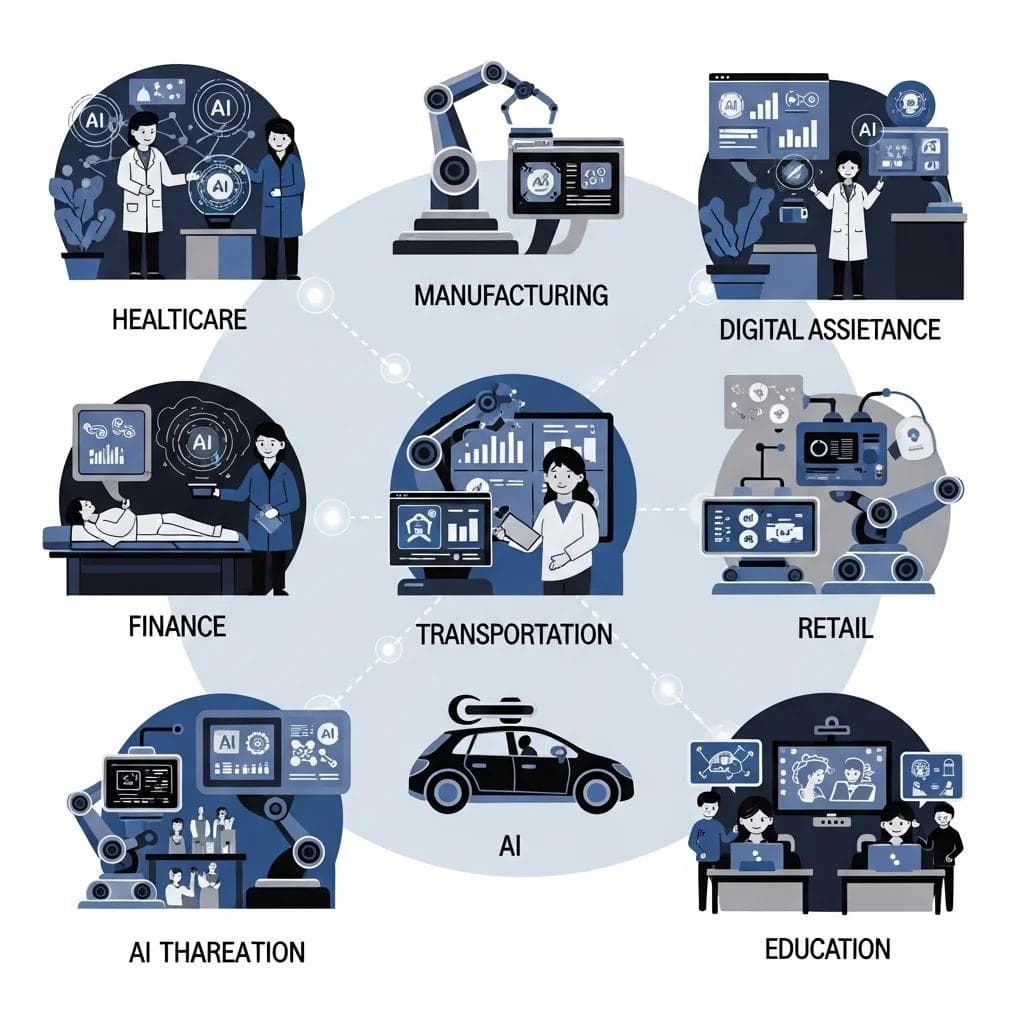
A diverse array of industry-themed vignettes, healthcare with doctors and AI holograms managing patient data, manufacturing with robotic...
Industry-Specific Applications and Case Studies
AI agents demonstrate remarkable versatility across different industries, with each sector leveraging their capabilities to address specific operational challenges.
Healthcare: Transforming Patient Care and Administration
Healthcare organizations are experiencing significant benefits from AI agent implementation:
Clinical Workflow Optimization: AI agents assist with chart-gap tracking, ensuring complete patient records and reducing administrative burden on healthcare providers. These agents automatically identify missing information and coordinate data collection across multiple systems.
Appointment Management: Hospital scheduling agents handle complex appointment requests, including rescheduling based on cancellations, coordinating multi-provider visits, and managing resource allocation. One notable example involves an AI agent automatically rescheduling an MRI appointment when a cancellation occurred, optimizing resource utilization without human intervention.
Prior Authorization Processing: Healthcare AI agents streamline insurance approval processes by automatically gathering required documentation, submitting requests, and tracking approval status. This automation reduces processing time from days to hours while maintaining compliance with regulatory requirements.
Financial Services: Enhancing Customer Experience and Compliance
The financial sector leverages AI agents for both customer-facing and back-office operations:
Claims Processing: Insurance companies report automation rates exceeding 90% for routine claims, with AI agents handling everything from initial assessment to settlement processing. These agents can evaluate policy coverage, assess damage reports, and coordinate with repair vendors autonomously.
Customer Service: Financial AI agents handle complex customer inquiries that require accessing multiple account systems, transaction histories, and policy documents. Unlike simple chatbots, these agents can initiate account changes, process requests, and coordinate with other departments.
Compliance Monitoring: AI agents continuously monitor transactions and activities for compliance violations, automatically generating reports and initiating corrective actions when necessary.
Manufacturing and Field Services: Optimizing Operations
AI agents are revolutionizing field service operations by providing real-time diagnostic assistance and predictive maintenance capabilities.
Field technician AI agents synthesize operational data to provide context-specific guidance during equipment maintenance and repair. These agents can:
- Analyze equipment performance data to predict potential failures
- Guide technicians through complex troubleshooting procedures
- Coordinate parts ordering and scheduling based on diagnostic results
- Update maintenance records and trigger follow-up actions automatically
This application addresses the growing skills shortage in technical fields by augmenting human expertise with intelligent assistance.
Retail and E-commerce: Personalizing Customer Experiences
Retail AI agents create personalized shopping experiences by:
- Analyzing customer behavior patterns to recommend products
- Managing inventory across multiple channels and locations
- Coordinating marketing campaigns based on customer segments
- Handling complex order fulfillment scenarios including returns and exchanges
AI Agents vs. Traditional Business Software
Understanding the distinctions between AI agents and traditional business software helps organizations make informed technology decisions.
Fundamental Operational Differences
Traditional Software Characteristics:
- Requires explicit user input for each action
- Follows predetermined workflows and rules
- Limited ability to handle exceptions or unexpected scenarios
- Operates within single applications or systems
- Provides consistent but inflexible responses
AI Agent Characteristics:
- Initiates actions based on goals and environmental conditions
- Creates dynamic workflows adapted to specific situations
- Handles exceptions through reasoning and alternative planning
- Integrates across multiple systems and data sources
- Learns and improves performance over time
Decision-Making and Problem-Solving
Traditional automation breaks when encountering situations outside predefined parameters. AI agents excel in environments with uncertainty, incomplete information, and changing conditions.
For example, when processing a customer service request:
Traditional System: Follows a decision tree based on predefined categories, escalating to humans when the request doesn't match existing options.
AI Agent: Analyzes the request context, accesses relevant customer history, evaluates multiple resolution options, and takes appropriate action while learning from the outcome for future similar situations.
Implementation and Maintenance Considerations
Traditional Software:
- Requires extensive upfront configuration and rule definition
- Needs manual updates when business processes change
- Limited adaptability to new scenarios
- Predictable but potentially outdated performance
AI Agents:
- Learn from existing data and processes during implementation
- Adapt automatically to process changes and new scenarios
- Continuous improvement through machine learning
- Dynamic performance that evolves with business needs
Implementation Strategy and Best Practices
Successful AI agent implementation requires strategic planning and systematic execution to maximize business value and minimize disruption.
Identifying Optimal Use Cases
The most successful AI agent implementations target high-friction processes with clear, measurable outcomes. Organizations should evaluate potential use cases based on:
Process Complexity: Tasks involving multiple steps, decision points, and system interactions benefit most from AI agent automation.
Data Availability: Processes with rich historical data and clear success metrics provide the foundation for effective agent training and optimization.
Business Impact: Focus on processes that directly affect customer experience, operational costs, or strategic objectives.
Human Resource Constraints: Areas where skilled personnel are scarce or where routine tasks consume significant time are prime candidates for agent implementation.
Phased Implementation Approach
Successful organizations typically follow a structured implementation methodology:
Phase 1: Pilot Development
- Select a single, well-defined process for initial implementation
- Establish clear success metrics and measurement frameworks
- Develop the AI agent with limited scope and controlled variables
- Monitor performance and gather feedback from stakeholders
Phase 2: Optimization and Expansion
- Refine agent performance based on pilot results
- Expand functionality to handle additional scenarios and edge cases
- Integrate with additional systems and data sources
- Scale to higher transaction volumes
Phase 3: Enterprise Deployment
- Deploy across multiple departments or business units
- Implement governance frameworks and monitoring systems
- Establish maintenance and continuous improvement processes
- Train staff on collaboration with AI agents
Integration with Existing Systems
AI agents achieve maximum value when seamlessly integrated with existing business infrastructure. Key integration considerations include:
API Connectivity: Ensure agents can access and update relevant business systems through secure, well-documented APIs.
Data Governance: Establish clear policies for data access, privacy protection, and compliance with regulatory requirements.
Security Protocols: Implement appropriate authentication, authorization, and monitoring systems to protect sensitive business information.
Change Management: Prepare staff for new workflows and collaboration models with AI agents through training and communication programs.
Future Outlook and Emerging Trends
The AI agent landscape continues evolving rapidly, with emerging trends shaping the future of business automation and human-AI collaboration.
Advanced Reasoning Capabilities
Next-generation AI agents will demonstrate increasingly sophisticated reasoning abilities, enabling them to handle complex strategic decisions and creative problem-solving tasks. These advances include:
- Multi-modal reasoning combining text, images, and structured data
- Long-term planning capabilities spanning weeks or months
- Collaborative reasoning between multiple specialized agents
- Integration with external knowledge sources and real-time information
Industry-Specific Specialization
AI agents are becoming increasingly specialized for specific industries and use cases:
Healthcare Agents: Advanced clinical decision support, personalized treatment planning, and predictive health monitoring
Financial Agents: Sophisticated risk assessment, regulatory compliance automation, and personalized financial advisory services
Manufacturing Agents: Predictive maintenance, supply chain optimization, and quality control automation
Human-AI Collaboration Models
The future of AI agents lies not in replacing human workers but in creating sophisticated collaboration models that amplify human capabilities. Emerging patterns include:
- AI agents handling routine and analytical tasks while humans focus on strategic and creative work
- Collaborative decision-making where agents provide data-driven insights and humans provide contextual judgment
- Adaptive role allocation based on task complexity and available expertise
Organizations that successfully navigate this transition will gain significant competitive advantages through enhanced productivity, improved decision-making, and more engaging work experiences for their employees.
Frequently Asked Questions
What is the difference between AI agents and chatbots?
AI agents operate autonomously across multiple systems and workflows, while chatbots primarily respond to user queries within conversational interfaces. AI agents can initiate tasks, make decisions, and execute complex processes without human prompts, whereas chatbots require user input to function.
How much does it cost to implement AI agents in business?
Implementation costs vary significantly based on complexity, integration requirements, and scale. Small-scale implementations may cost $50,000-$200,000, while enterprise-wide deployments can range from $500,000-$2 million. However, most organizations report ROI within 6-18 months through operational efficiency gains.
What types of businesses benefit most from AI agents?
Businesses with high-volume, multi-step processes benefit most from AI agents. This includes healthcare organizations, financial services, insurance companies, manufacturing firms, and retail operations. Companies with significant administrative overhead or customer service demands typically see the greatest impact.
How long does it take to implement AI agents?
Implementation timelines range from 3-6 months for simple use cases to 12-18 months for complex enterprise deployments. Factors affecting timeline include system integration complexity, data preparation requirements, and organizational change management needs.
Do AI agents require specialized technical expertise to manage?
While initial implementation requires technical expertise, modern AI agent platforms are designed for business user management. Organizations typically need technical support during setup and integration, but day-to-day management can be handled by business analysts and process owners.
Can AI agents work with existing business software?
Yes, AI agents are designed to integrate with existing business systems through APIs and standard integration protocols. They can work with CRM systems, ERP platforms, databases, and most modern business applications without requiring system replacements.
What security considerations apply to AI agents?
AI agents require robust security frameworks including data encryption, access controls, audit logging, and compliance monitoring. Organizations must ensure agents operate within established security policies and regulatory requirements, particularly when handling sensitive customer or business data.
How do you measure the success of AI agent implementation?
Success metrics include process automation rates, cost reduction, processing time improvements, error rate reductions, and customer satisfaction scores. Most organizations track ROI through operational efficiency gains, reduced labor costs, and improved service quality metrics.
What happens when AI agents encounter situations they cannot handle?
Well-designed AI agents include escalation protocols that route complex or unusual situations to human operators. They can identify their limitations, document the issue, and ensure seamless handoff to appropriate personnel while continuing to handle other tasks.
How do AI agents learn and improve over time?
AI agents use machine learning algorithms to analyze their performance, identify patterns in successful outcomes, and adapt their decision-making processes. They continuously refine their approaches based on feedback, new data, and changing business conditions, becoming more effective over time.
AI agents represent a fundamental shift from reactive software tools to proactive business collaborators. Their value lies not in replacing human judgment but in orchestrating complex workflows, synthesizing information across systems, and enabling organizations to focus human talent on strategic, creative, and relationship-building activities.
As businesses increasingly adopt agent-based systems, the competitive advantage will belong to organizations that successfully integrate these technologies into their operations while maintaining the human expertise and judgment that drive innovation and customer relationships. The future of business software is autonomous, adaptive, and collaborative—and that future is available today.
Community
Join the conversation
More Blog Posts

AI Agents in Enterprise Workflows: Transforming Business Operations for 2026
Discover how AI agents are revolutionizing enterprise workflows, transforming businesses into proactive, autonomous entities that enhance efficiency and drive measurable value.

Scaling AI Solutions: From Prototype to Production Best Practices
Learn how to successfully scale AI solutions from prototype to production, focusing on key practices that align data engineering with business goals, especially in healthcare.

AI in Manufacturing: From Buzzwords to Measurable Business Value
Discover how AI can enhance manufacturing operations through practical automation and decision support, delivering real value without disruptive overhauls.