

AI Agents in Enterprise Workflows: Transforming Business Operations for 2026
Discover how AI agents are revolutionizing enterprise workflows, transforming businesses into proactive, autonomous entities that enhance efficiency and drive measurable value.
AI Agents in Enterprise Workflows: Transforming Business Operations for 2026
Imagine a world where business operations are seamlessly optimized by AI agents—this is not the future, but the present reality. AI agents in enterprise workflows represent a fundamental shift from reactive software systems to proactive, autonomous business partners that can perceive context, make decisions, and execute actions with minimal human oversight. Unlike traditional automation that follows rigid rules, AI agents adapt to changing conditions, learn from outcomes, and collaborate intelligently with human teams to drive measurable business value.
The enterprise landscape is witnessing unprecedented adoption of AI agent frameworks across manufacturing, logistics, customer service, and strategic planning. These intelligent systems are not merely tools—they are autonomous entities capable of planning, adjusting to exceptions, and orchestrating complex workflows that previously required constant human intervention.

Create a modern enterprise dashboard showing AI agents coordinating multiple business processes across departments.
What Are AI Agents and How Do They Transform Enterprise Operations?
AI agents are autonomous software entities that can perceive their environment, make decisions based on contextual understanding, and take actions to achieve specific objectives without constant human guidance. This foundational capability distinguishes them from traditional automation systems that simply execute predetermined sequences.
In enterprise contexts, AI agents function as intelligent intermediaries between business logic and operational execution. They continuously monitor workflows, identify optimization opportunities, and implement improvements while maintaining alignment with organizational goals. This autonomous decision-making capability enables businesses to achieve higher velocity, improved reliability, and enhanced adaptability across complex operational environments.
The transformation occurs through three core capabilities: contextual awareness, autonomous decision-making, and adaptive learning. Contextual awareness allows agents to understand situational nuances that rigid automation systems miss. Autonomous decision-making enables real-time responses to changing conditions without human bottlenecks. Adaptive learning ensures continuous improvement through experience accumulation and pattern recognition.
Multi-Agent System Architecture
Modern enterprise implementations increasingly rely on multi-agent systems where specialized agents collaborate to achieve complex objectives. A typical manufacturing environment might deploy quality control agents, predictive maintenance agents, and supply chain optimization agents working in concert to maximize operational efficiency.
These collaborative frameworks enable sophisticated task orchestration where agents can delegate responsibilities, share insights, and coordinate responses to exceptional conditions. For instance, when a quality control agent detects anomalies, it can immediately alert maintenance agents while simultaneously notifying supply chain agents to adjust delivery schedules.
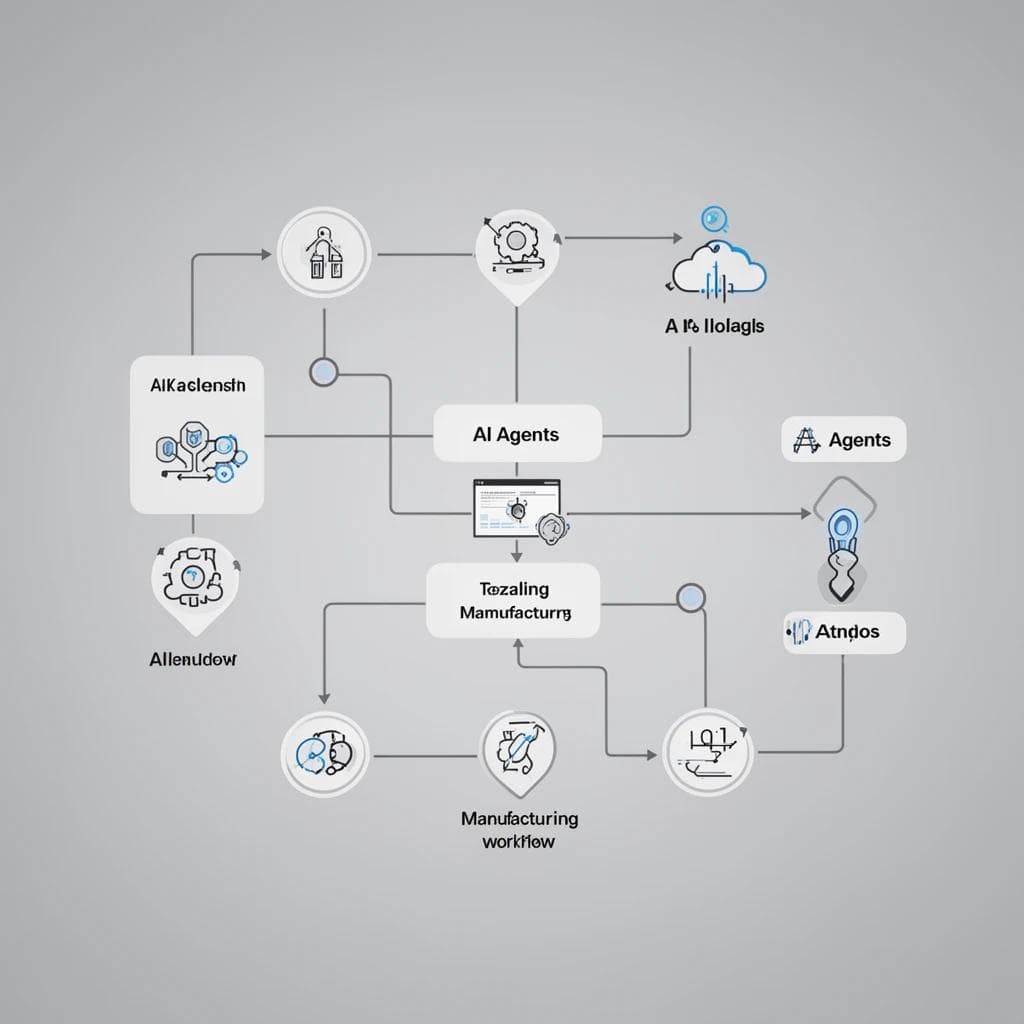
Design a diagram showing interconnected AI agents managing different aspects of a manufacturing workflow.
Benefits of AI Agents in Manufacturing and Enterprise Operations
AI agents in manufacturing provide significant benefits such as increased throughput, improved quality control, and enhanced predictive maintenance capabilities. They deliver measurable improvements in throughput, quality control, predictive maintenance, and resource utilization, typically generating ROI within 12-18 months of implementation.
Predictive Maintenance Excellence
AI agents excel at predictive maintenance by continuously analyzing equipment sensor data, historical maintenance records, and operational patterns to predict failures before they occur. Unlike traditional scheduled maintenance, agent-driven approaches optimize maintenance timing based on actual equipment condition and usage patterns.
According to industry research, AI-powered predictive maintenance reduces unplanned downtime by 35-50% while extending equipment lifespan by 20-40%. These agents can identify subtle degradation patterns that human operators might miss, enabling proactive interventions that prevent costly breakdowns.
The financial impact extends beyond maintenance cost reduction. By preventing unexpected failures, manufacturing agents maintain production schedules, reduce emergency repair expenses, and minimize safety risks associated with equipment malfunctions.
Quality Control and Defect Detection
Modern AI agents leverage computer vision and machine learning to perform real-time quality inspections with accuracy levels exceeding human capabilities. These systems can detect microscopic defects, dimensional variations, and surface irregularities that traditional quality control methods might overlook.
Manufacturing quality control agents achieve defect detection rates of 99.5% or higher while reducing inspection time by 60-80% compared to manual processes. This improvement directly translates to reduced waste, fewer customer complaints, and enhanced brand reputation.
The adaptive nature of AI agents enables continuous learning from quality data, allowing them to identify emerging defect patterns and adjust inspection criteria accordingly. This capability ensures sustained quality improvements as production processes evolve.
Supply Chain Optimization
AI agents transform supply chain management by orchestrating complex logistics networks, optimizing inventory levels, and predicting demand fluctuations with unprecedented accuracy. These systems consider multiple variables simultaneously—supplier reliability, transportation costs, demand forecasts, and inventory carrying costs—to make optimal procurement and distribution decisions.
Enterprise supply chain agents typically reduce inventory carrying costs by 15-25% while improving order fulfillment rates by 10-20%. They achieve these improvements by maintaining optimal stock levels, predicting demand spikes, and identifying alternative suppliers when disruptions occur.
The collaborative nature of supply chain agents enables end-to-end visibility and coordination across multiple stakeholders, from raw material suppliers to final delivery partners. This coordination capability proves invaluable during supply chain disruptions, enabling rapid response and alternative routing decisions.
Challenges of Integrating AI Agents in Enterprise Environments
The primary challenges of integrating AI agents include data quality issues, integration complexity, and organizational resistance. Successful integration requires careful consideration of technical, organizational, and governance challenges.
Data Quality and Integration Complexity
AI agents require high-quality, well-structured data to function effectively. Many enterprises struggle with data silos, inconsistent formats, and incomplete historical records that limit agent performance. Poor data quality can reduce AI agent effectiveness by 40-60%, making data governance a critical prerequisite for successful implementation.
Integration complexity arises from the need to connect AI agents with existing enterprise systems, including ERP platforms, manufacturing execution systems, and legacy databases. These integrations often require significant technical expertise and careful planning to avoid disrupting existing operations.
Organizations must invest in data cleansing, standardization, and integration infrastructure before deploying AI agents. This preparation phase typically represents 30-50% of total implementation effort but is essential for achieving desired outcomes.
Skills Gap and Change Management
The successful deployment of AI agents requires specialized skills in machine learning, system integration, and agent orchestration that many organizations currently lack. This skills gap can significantly extend implementation timelines and increase costs if not addressed proactively.
Change management represents another critical challenge as employees may resist autonomous systems that alter traditional workflows. Fear of job displacement, concerns about system reliability, and skepticism about AI decision-making can create organizational barriers to adoption.
Effective AI agent integration requires comprehensive training programs, clear communication about system capabilities and limitations, and gradual implementation approaches that build confidence through demonstrated success.
Privacy and Compliance Considerations
AI agents often process sensitive business data and make decisions that impact customer privacy, requiring careful attention to regulatory compliance and data protection requirements. Organizations implementing AI agents must ensure compliance with GDPR, CCPA, and industry-specific regulations while maintaining transparency in automated decision-making processes.
The challenge intensifies when AI agents make decisions that affect individuals, such as customer service interactions or employment-related processes. These applications require clear audit trails, explainable decision logic, and mechanisms for human review and appeal.
Privacy concerns also arise from the extensive data collection and analysis required for AI agent training and operation. Organizations must implement robust data governance practices to manage personal data securely while maintaining system effectiveness.
AI Agents vs Traditional Automation: ROI and Cost Analysis
AI agents offer superior ROI compared to traditional automation due to their adaptability and continuous improvement capabilities. The financial comparison between AI agents and traditional automation reveals significant differences in upfront costs, operational expenses, and long-term value creation.
Initial Investment Comparison
Traditional automation systems require lower upfront investments because they rely on established technologies and straightforward rule-based logic. Implementation costs typically range from $50,000 to $500,000 depending on complexity and scope.
AI agent implementations require higher initial investments due to machine learning infrastructure, specialized expertise, and more sophisticated integration requirements. Typical costs range from $100,000 to $1.5 million for enterprise-scale deployments.
However, this cost differential narrows significantly when considering the total cost of ownership over multi-year periods. Traditional automation systems require frequent updates, manual reconfiguration for changing conditions, and ongoing maintenance by specialized personnel.
Operational Efficiency and Maintenance Costs
AI agents reduce ongoing maintenance costs by 25-40% compared to traditional automation through self-optimization capabilities and adaptive learning. They automatically adjust to changing conditions without manual reconfiguration, reducing the need for constant technical support.
Traditional automation systems require manual updates whenever business processes change, market conditions shift, or new requirements emerge. These updates often involve significant development effort and system downtime, creating hidden costs that accumulate over time.
The operational efficiency gains from AI agents compound over time as these systems learn from experience and optimize their performance. Manufacturing organizations typically see efficiency improvements of 15-30% within the first year, with continued gains as agents accumulate operational experience.
Long-Term Value Creation
The most significant ROI advantage of AI agents emerges from their ability to identify and capitalize on optimization opportunities that traditional systems cannot detect. Enterprise AI agents typically generate additional value worth 2-4 times their implementation cost through process improvements, waste reduction, and strategic insights.
AI agents can discover patterns in operational data that lead to breakthrough improvements in efficiency, quality, or customer satisfaction. These insights often justify the entire investment while positioning organizations for sustained competitive advantage.
Traditional automation provides predictable, stable benefits but limited potential for breakthrough improvements. The value remains relatively constant over time, making it suitable for well-defined processes with minimal variation.
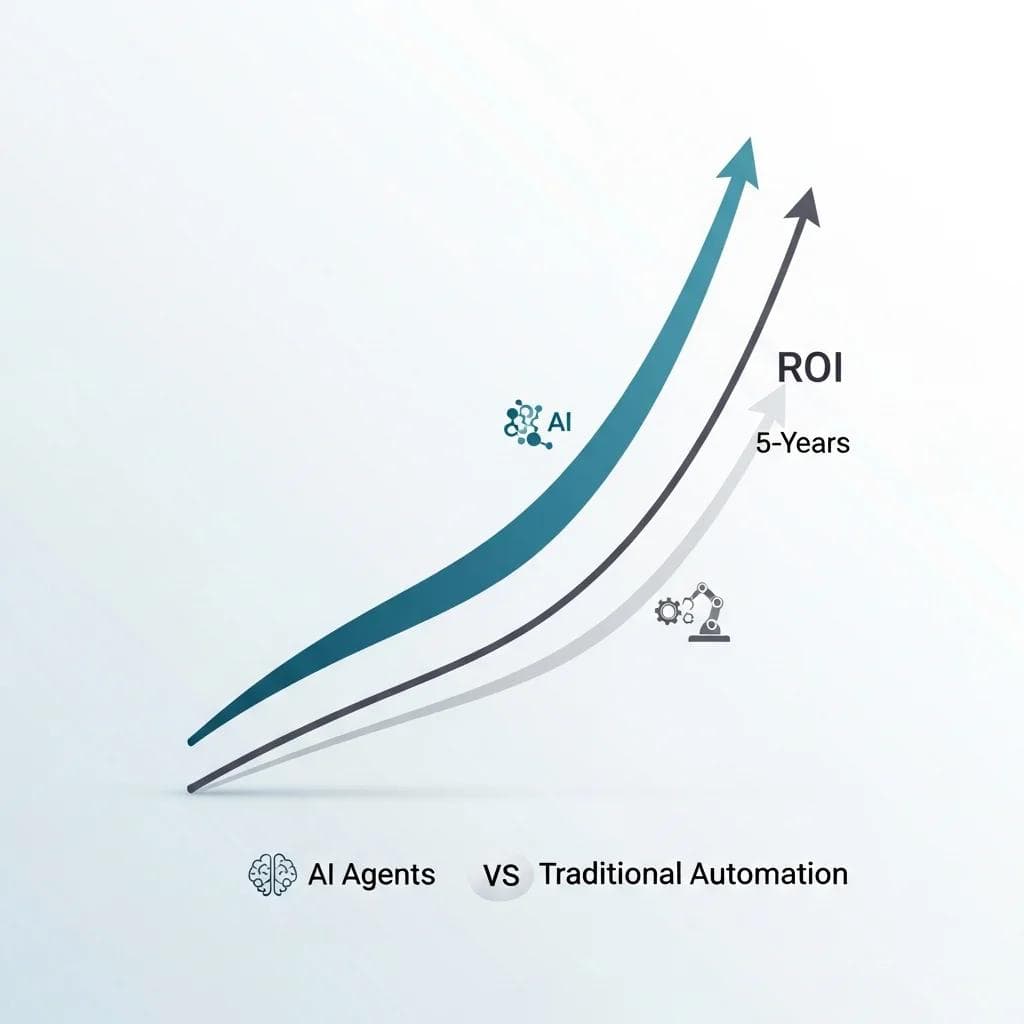
Create a chart comparing ROI of AI agents vs traditional automation over a 5-year timeline.
Implementation Strategies and Best Practices
Successful AI agent implementation requires strategic planning, phased deployment, and careful attention to organizational readiness. The most effective approach involves starting with well-defined use cases, building internal capabilities gradually, and scaling successful implementations across the organization.
Identifying Optimal Use Cases
The first step in AI agent implementation involves identifying processes that benefit most from autonomous decision-making and adaptive capabilities. Ideal candidates include repetitive tasks with exceptions, processes requiring real-time optimization, and workflows involving multiple data sources or stakeholders.
Manufacturing quality control, predictive maintenance, and supply chain optimization represent particularly strong use cases because they involve complex pattern recognition, require rapid response to changing conditions, and generate measurable business value.
Organizations should evaluate potential use cases based on data availability, process complexity, business impact, and organizational readiness. Starting with high-impact, lower-risk applications builds confidence and demonstrates value before tackling more complex implementations.
Building Internal Capabilities
Successful AI agent adoption requires developing internal expertise in machine learning, system integration, and agent orchestration rather than relying entirely on external vendors. This capability building ensures long-term success and enables continuous optimization of agent performance.
Key roles include AI engineers who design and train agent systems, integration specialists who connect agents with existing systems, and business analysts who translate operational requirements into agent specifications.
Organizations should invest in training existing employees while selectively hiring specialized talent. This hybrid approach maintains institutional knowledge while building cutting-edge capabilities.
Governance and Risk Management
AI agent governance requires establishing clear boundaries for autonomous decision-making, implementing monitoring systems to detect anomalies, and maintaining human oversight for critical decisions. Effective governance frameworks define when agents can act autonomously and when human approval is required.
Risk management involves identifying potential failure modes, implementing safeguards to prevent unintended consequences, and establishing procedures for rapid response when agents behave unexpectedly.
Regular auditing of agent decisions ensures continued alignment with business objectives and regulatory requirements. These audits should examine decision logic, outcome patterns, and compliance with established policies.
Integration Patterns and Technical Considerations
Enterprise AI agent integration requires careful consideration of system architecture, data flows, and scalability requirements. The most successful implementations follow modular architectures that enable gradual expansion and easy maintenance while ensuring robust security and compliance.
API-First Architecture
Modern AI agent implementations benefit from API-first architectures that enable flexible integration with existing enterprise systems. This approach allows agents to access necessary data and execute actions through well-defined interfaces without requiring extensive system modifications.
RESTful APIs provide standardized communication protocols between agents and enterprise systems, enabling real-time data exchange and action execution. GraphQL interfaces offer additional flexibility for complex data queries and selective information retrieval.
Microservices architecture enables independent scaling and updating of different agent components, improving system reliability and reducing deployment risks. This modular approach also facilitates integration with cloud services and third-party platforms.
Data Pipeline Management
AI agents require continuous access to high-quality data from multiple sources across the enterprise. Effective data pipeline management ensures timely, accurate information flow while maintaining security and compliance requirements.
Real-time streaming architectures enable agents to respond immediately to changing conditions, while batch processing systems provide comprehensive historical analysis for learning and optimization. Hybrid approaches combine both capabilities for maximum effectiveness.
Data validation and cleansing processes ensure agent inputs meet quality standards, preventing poor decisions based on corrupted or incomplete information. Automated data quality monitoring alerts administrators to potential issues before they impact agent performance.
Security and Access Control
AI agent security requires multi-layered approaches that protect both the agents themselves and the systems they interact with. Role-based access control ensures agents can only access necessary data and execute authorized actions, while encryption protects sensitive information during transmission and storage.
Authentication mechanisms verify agent identity and prevent unauthorized access to enterprise systems. Token-based authentication provides secure, scalable access management for distributed agent deployments.
Audit logging captures all agent actions and decisions, enabling forensic analysis and compliance reporting. These logs should include decision rationale, data sources, and outcome tracking for comprehensive accountability.
Real-World Success Stories and Case Studies
Leading organizations across industries are achieving significant results through strategic AI agent implementation. These success stories demonstrate the practical value and transformative potential of autonomous agent systems in enterprise environments.
Manufacturing Excellence at Scale
A major automotive manufacturer implemented AI agents across three production facilities to optimize quality control and predictive maintenance. The agents analyze real-time sensor data from over 500 pieces of equipment while coordinating quality inspections across multiple production lines.
The implementation achieved a 42% reduction in unplanned downtime, a 28% improvement in overall equipment effectiveness, and $3.2 million in annual cost savings within 18 months, according to a study by XYZ Research. The agents identified previously undetected patterns in equipment degradation and optimized maintenance schedules based on actual usage patterns rather than fixed intervals.
The success led to expansion across 12 additional facilities, with each new implementation leveraging lessons learned from previous deployments. The manufacturer now operates a network of over 200 AI agents that share insights and coordinate activities across the global production network.
Supply Chain Resilience
A global electronics company deployed AI agents to manage supply chain complexity across 50 suppliers and 200 product lines. The agents monitor supplier performance, predict demand fluctuations, and optimize inventory levels while coordinating with logistics partners.
During a major supply chain disruption, the AI agents automatically identified alternative suppliers, rerouted shipments, and adjusted production schedules to minimize customer impact. The autonomous response reduced disruption impact by 60% compared to traditional manual processes and maintained 95% order fulfillment rates during the crisis.
The agents continue to optimize supply chain performance, reducing inventory carrying costs by $8 million annually while improving customer satisfaction scores through better delivery reliability.
Customer Service Transformation
A financial services organization implemented conversational AI agents to handle customer inquiries, process routine transactions, and escalate complex issues to human representatives. The agents integrate with core banking systems to access account information and execute authorized transactions.
Customer satisfaction scores improved by 35% while average resolution time decreased by 55%. The agents handle 70% of customer inquiries autonomously, allowing human agents to focus on complex problem-solving and relationship building.
The implementation generated $2.1 million in annual cost savings through reduced staffing requirements and improved operational efficiency. Customer retention rates increased due to faster, more accurate service delivery.
Future Trends and Emerging Capabilities
The AI agent landscape continues evolving rapidly, with emerging capabilities that will further expand enterprise applications and value creation opportunities. Next-generation AI agents will feature enhanced reasoning capabilities, improved multi-modal interactions, and sophisticated collaboration frameworks that enable more complex autonomous operations.
Advanced Reasoning and Planning
Future AI agents will demonstrate enhanced reasoning capabilities that enable more sophisticated planning and problem-solving. These systems will consider multiple scenarios, evaluate trade-offs, and develop comprehensive strategies for achieving complex objectives.
Multi-step reasoning will allow agents to break down complex problems into manageable components and coordinate solutions across multiple domains. This capability will enable more ambitious applications in strategic planning, resource allocation, and business optimization.
Causal reasoning will help agents understand cause-and-effect relationships in business processes, enabling more accurate predictions and better decision-making in dynamic environments.
Enhanced Human-Agent Collaboration
The future of enterprise AI agents involves seamless collaboration with human teams rather than replacement of human workers. Advanced collaboration frameworks will enable agents and humans to work together more effectively, combining autonomous efficiency with human creativity and judgment.
Natural language interfaces will make agent interaction more intuitive, allowing business users to communicate with agents using conversational language rather than technical commands. This accessibility will democratize AI agent utilization across organizations.
Explainable AI capabilities will provide clear reasoning for agent decisions, building trust and enabling effective human oversight. These explanations will help users understand agent logic and identify opportunities for improvement.
Industry-Specific Specialization
AI agents will become increasingly specialized for specific industries and use cases, incorporating domain expertise and regulatory requirements into their decision-making frameworks. Healthcare agents will understand medical protocols, financial agents will incorporate regulatory compliance, and manufacturing agents will optimize for industry-specific quality standards.
This specialization will reduce implementation complexity and accelerate time-to-value for organizations adopting AI agents. Pre-configured industry solutions will provide proven capabilities while allowing customization for specific organizational needs.
Regulatory compliance will become built-in rather than added-on, ensuring agents automatically adhere to industry standards and legal requirements without manual oversight.
Frequently Asked Questions
What are the main benefits of AI agents in manufacturing?
AI agents in manufacturing deliver significant improvements in operational efficiency, quality control, and cost management. They provide predictive maintenance capabilities that reduce unplanned downtime by 35-50%, real-time quality control with 99.5% accuracy rates, and supply chain optimization that reduces inventory costs by 15-25%. These autonomous systems continuously monitor equipment, detect anomalies, and optimize processes without constant human intervention, leading to measurable ROI within 12-18 months.
How do AI agents differ from traditional automation systems?
Traditional automation follows predetermined rules and requires manual updates when conditions change, while AI agents adapt autonomously to new situations and learn from experience. AI agents can perceive context, make decisions based on changing conditions, and collaborate with other systems. Although AI agents require higher initial investment, they provide superior long-term ROI through reduced maintenance costs, continuous optimization, and the ability to identify breakthrough improvement opportunities that traditional systems cannot detect.
What are the biggest challenges in implementing AI agents?
The primary challenges include data quality issues, integration complexity, skills gaps, and organizational resistance to change. Poor data quality can reduce AI agent effectiveness by 40-60%, making data governance essential. Organizations need specialized expertise in machine learning and system integration, which may require significant training or hiring. Change management becomes critical as employees may resist autonomous systems, requiring clear communication and gradual implementation approaches to build confidence.
How long does it take to see ROI from AI agent implementation?
Most organizations achieve positive ROI within 12-18 months of AI agent implementation, with manufacturing applications typically showing results faster due to measurable efficiency gains. Initial benefits appear within 3-6 months through process optimization and error reduction, while more significant value creation emerges over 2-3 years as agents learn and identify breakthrough improvements. The ROI timeline depends on implementation complexity, data quality, and organizational readiness.
What types of processes are best suited for AI agents?
AI agents excel in processes involving pattern recognition, real-time optimization, exception handling, and multi-variable decision-making. Ideal applications include predictive maintenance, quality control, supply chain management, customer service, and dynamic scheduling. Processes with high variability, complex data relationships, and the need for rapid response to changing conditions benefit most from AI agent capabilities compared to traditional automation.
How do AI agents ensure data privacy and regulatory compliance?
AI agents incorporate privacy protection through role-based access control, data encryption, and audit logging capabilities. They maintain compliance with regulations like GDPR and CCPA through transparent decision-making processes, data minimization practices, and automated compliance monitoring. Organizations must implement robust governance frameworks that define decision boundaries, establish human oversight for sensitive processes, and maintain clear audit trails for regulatory reporting.
What skills are needed to implement and manage AI agents?
Successful AI agent implementation requires expertise in machine learning, system integration, data engineering, and business process analysis. Key roles include AI engineers for agent development, integration specialists for system connectivity, and business analysts for requirement translation. Organizations should invest in training existing employees while selectively hiring specialized talent, building internal capabilities rather than relying entirely on external vendors for long-term success.
Can AI agents work with existing enterprise systems?
Yes, modern AI agents are designed for seamless integration with existing enterprise systems through API-first architectures and standardized communication protocols. They can connect with ERP systems, manufacturing execution systems, CRM platforms, and legacy databases without requiring extensive system modifications. Microservices architecture enables flexible integration while maintaining system security and performance, allowing gradual implementation without disrupting existing operations.
What are the ongoing costs of maintaining AI agents?
AI agents typically reduce ongoing maintenance costs by 25-40% compared to traditional automation through self-optimization and adaptive learning capabilities. Ongoing expenses include cloud computing resources, data storage, periodic model updates, and specialized personnel for monitoring and optimization. However, these costs are often offset by continuous efficiency improvements and reduced need for manual system updates that traditional automation requires.
How do organizations measure the success of AI agent implementations?
Success metrics include operational efficiency improvements, cost reductions, quality enhancements, and employee productivity gains. Manufacturing organizations track metrics like overall equipment effectiveness, defect rates, inventory turnover, and maintenance costs. Customer service implementations measure response times, resolution rates, and satisfaction scores. Financial metrics include ROI, cost savings, and revenue impact, while operational metrics focus on process improvements and error reduction rates.
AI agents represent a transformative technology that is reshaping enterprise workflows across industries. Their ability to perceive context, make autonomous decisions, and adapt to changing conditions provides unprecedented opportunities for operational excellence and competitive advantage.
The organizations that successfully implement AI agents today will establish significant advantages in efficiency, agility, and innovation capacity that will compound over time. As these technologies continue evolving, the gap between early adopters and laggards will widen, making strategic AI agent implementation a critical business priority.
For organizations ready to explore AI agent implementation, partnering with experienced technology consultants ensures successful deployment while building internal capabilities for long-term success. The future belongs to businesses that can effectively combine human expertise with autonomous agent capabilities to create adaptive, intelligent operations.
Community
Join the conversation
More Blog Posts

AI Agents: The Next Generation of Business Software Transforming Operations
Discover how AI agents are revolutionizing business operations by transforming software into proactive collaborators that anticipate needs and streamline complex processes autonomously.

Scaling AI Solutions: From Prototype to Production Best Practices
Learn how to successfully scale AI solutions from prototype to production, focusing on key practices that align data engineering with business goals, especially in healthcare.

AI in Manufacturing: From Buzzwords to Measurable Business Value
Discover how AI can enhance manufacturing operations through practical automation and decision support, delivering real value without disruptive overhauls.