
Chief AI Officer: Essential Leadership Models for Strategic AI Success
Discover the vital role of the Chief AI Officer in aligning AI strategies with business goals, managing risks, and fostering innovation for successful AI integration.
Chief AI Officer: Leadership Models for Strategic AI Success
As artificial intelligence transforms from experimental technology to business-critical infrastructure, organizations face a fundamental question: who owns AI strategy and execution? The emergence of the Chief AI Officer (CAIO) role highlights the need for dedicated AI leadership. This role is crucial for aligning AI initiatives with business objectives and managing risks effectively. AI needs ownership to succeed, and the right leadership model depends on your scale, ambition, and readiness—not on trends.
What is a Chief AI Officer?
What is a Chief AI Officer?
A Chief AI Officer (CAIO) is a senior executive responsible for developing and executing an organization's AI strategy, ensuring AI initiatives align with business objectives while managing risks and fostering innovation across the enterprise. According to IBM, the CAIO must navigate the complexities of AI adoption while building trust in AI systems and addressing ethical concerns.
The CAIO role emerged as organizations recognized that AI requires dedicated leadership to achieve meaningful business impact. Unlike traditional IT roles, the CAIO focuses on transformative business strategies rather than just technology implementation. PwC research indicates that successful CAIOs emphasize speed and innovation in AI adoption, mobilizing leadership to unlock AI value through business-led strategies.
The Chief AI Officer serves as the bridge between technical AI capabilities and strategic business outcomes, ensuring that AI investments deliver measurable value rather than remaining experimental projects. This role becomes particularly critical as AI reliability challenges emerge, with unreliable AI potentially leading to serious consequences in sectors like healthcare and finance.

An executive presenting an AI strategy dashboard to board members.
The AI Ownership Challenge: Why Leadership Models Matter
Traditional organizational structures struggle with AI ownership because artificial intelligence doesn't fit neatly into existing departmental boundaries. IT teams understand the technical infrastructure, product teams know customer needs, and R&D teams drive innovation—but AI requires all three perspectives working in harmony.
Organizations without clear AI ownership typically experience 40-60% longer implementation timelines and significantly higher failure rates compared to those with dedicated AI leadership structures. This fragmentation leads to several critical problems:
Common AI Ownership Problems
Siloed Development: Different departments develop AI solutions independently, creating duplicate efforts and incompatible systems. Marketing might build customer segmentation models while sales creates similar lead scoring algorithms, wasting resources and creating data inconsistencies.
Inconsistent Standards: Without central oversight, AI projects follow different quality standards, security protocols, and governance frameworks. This inconsistency creates compliance risks and makes it difficult to scale successful initiatives across the organization.
Resource Competition: Departments compete for AI talent, data resources, and budget allocation without strategic coordination. This competition drives up costs and slows overall progress.
Limited Strategic Vision: Individual departments optimize for local objectives rather than enterprise-wide AI transformation. The result is tactical implementations that fail to deliver strategic competitive advantages.

An organizational chart showing fragmented AI initiatives across departments.
AI Leadership Model 1: Internal AI Champions
The internal champion model distributes AI leadership across existing roles and departments, with designated individuals driving AI adoption within their functional areas. This approach leverages existing organizational knowledge while building AI capabilities organically.
How Internal Champions Work
Internal AI champions are existing employees who receive additional training and responsibility for driving AI initiatives within their departments while maintaining their primary roles. These champions typically include data scientists, product managers, or technically-minded business leaders who can bridge the gap between AI possibilities and business needs.
The champion model works best in organizations with strong collaborative cultures and existing technical talent. Champions coordinate through regular cross-functional meetings, shared resources, and common governance frameworks established by senior leadership.
Advantages of the Champion Approach
Faster Implementation: Champions understand existing business processes and can identify AI opportunities without lengthy onboarding periods. They can prototype solutions quickly using their domain expertise.
Lower Costs: Organizations avoid hiring expensive executive-level AI talent while building internal capabilities. Training existing employees typically costs 60-70% less than external hiring for similar expertise levels.
Cultural Integration: Internal champions naturally understand organizational culture and can navigate political dynamics more effectively than external hires. They build AI acceptance through trusted relationships.
Distributed Innovation: Multiple champions can pursue AI opportunities simultaneously across different business units, accelerating overall adoption and creating diverse use cases.
Challenges and Limitations
Competing Priorities: Champions must balance AI responsibilities with their primary roles, potentially limiting the time and attention they can dedicate to AI initiatives. This divided focus can slow progress on complex projects.
Limited Strategic Coordination: Without central leadership, champions may pursue conflicting directions or duplicate efforts. Individual departments might optimize locally while missing enterprise-wide opportunities.
Skill Development Gaps: Champions may lack deep AI expertise, limiting their ability to evaluate complex technical solutions or anticipate implementation challenges.
Accountability Issues: When AI projects fail, it can be difficult to determine responsibility across multiple champions, making it harder to learn from mistakes and improve processes.

Network_diagram.
AI Leadership Model 2: Centralized AI Teams and Centers of Excellence
The centralized model creates dedicated AI teams or Centers of Excellence (CoE) that serve the entire organization. These teams combine technical expertise, strategic planning, and operational support under unified leadership.
Structure of Centralized AI Teams
A centralized AI team operates as a shared service organization, providing AI strategy, development, and support services to business units while maintaining consistent standards and governance across all initiatives. The team typically includes data scientists, ML engineers, AI researchers, and business analysts who work together on enterprise-wide AI initiatives.
Centralized teams often establish AI Centers of Excellence that combine research, development, and operational capabilities. According to MIT Sloan Management Review, successful AI implementations require foundational elements like data cleansing and risk management that centralized teams can provide more efficiently than distributed efforts.
Benefits of Centralization
Consistent Standards: Centralized teams establish uniform AI governance, security protocols, and quality standards across all projects. This consistency reduces compliance risks and ensures reliable AI performance throughout the organization.
Resource Optimization: Shared AI infrastructure, tools, and expertise reduce overall costs while providing access to capabilities that individual departments couldn't afford independently. Organizations typically see 30-40% cost savings through resource consolidation.
Strategic Alignment: Central leadership ensures AI initiatives support overall business strategy rather than departmental objectives. This alignment creates synergies between projects and maximizes organizational impact.
Expertise Development: Concentrated AI talent can tackle more complex challenges and develop deeper expertise through collaboration. Teams can invest in advanced capabilities that benefit the entire organization.
Implementation Challenges
Slower Response Times: Centralized teams must prioritize requests from multiple business units, potentially creating bottlenecks for time-sensitive projects. Business units may experience longer wait times for AI support.
Business Context Gaps: Central teams may lack deep understanding of specific business unit needs, leading to solutions that don't fully address operational requirements or user preferences.
Change Management Resistance: Business units may resist centralized AI initiatives, preferring to maintain control over their technology decisions. This resistance can slow adoption and limit project success.
Scalability Constraints: As AI demand grows, centralized teams may struggle to support all organizational needs without significant resource expansion.

Organizational_structure.
AI Leadership Model 3: The Chief AI Officer Approach
The Chief AI Officer model creates a dedicated C-suite executive role responsible for enterprise-wide AI strategy, implementation, and governance. This approach provides the highest level of organizational commitment and strategic focus.
CAIO Responsibilities and Scope
The Chief AI Officer leads transformative changes in business strategies and operational models, mobilizing leadership to unlock AI value through comprehensive business-led strategies. According to PwC research, successful CAIOs focus on speed and innovation rather than just scale, ensuring AI initiatives deliver competitive advantages.
Key CAIO responsibilities include:
- Strategic Planning: Developing enterprise AI strategy aligned with business objectives
- Resource Allocation: Managing AI budgets, talent acquisition, and technology investments
- Risk Management: Establishing AI governance, ethics frameworks, and compliance protocols
- Stakeholder Engagement: Building AI literacy across leadership and driving cultural change
- Performance Measurement: Defining AI success metrics and tracking business impact
When Organizations Need a CAIO
Organizations benefit most from a Chief AI Officer when AI represents a core competitive differentiator, annual AI investments exceed $5 million, or AI initiatives span multiple business units requiring executive coordination. The CAIO role becomes essential when AI complexity surpasses what existing leadership can manage effectively.
Specific indicators for CAIO need include:
- Scale Requirements: Organizations with 1,000+ employees or multiple business units
- Strategic Importance: AI directly impacts core business models or customer value propositions
- Regulatory Complexity: Highly regulated industries requiring sophisticated AI governance
- Competitive Pressure: Markets where AI capabilities determine competitive positioning
CAIO Success Factors
Effective Chief AI Officers combine deep technical understanding with business acumen, enabling them to translate AI capabilities into strategic business outcomes while managing organizational change. IBM research emphasizes that CAIOs must build trust in AI systems while fostering an AI-ready culture.
Critical success factors include:
- Executive Support: Board and CEO commitment to AI transformation
- Cross-Functional Authority: Ability to influence decisions across business units
- Technical Credibility: Understanding of AI capabilities and limitations
- Change Leadership: Skills in organizational transformation and culture development
- Stakeholder Management: Ability to align diverse interests around AI initiatives
Potential Drawbacks
Bureaucratic Overhead: Adding another C-suite role can create additional layers of approval and slow decision-making, particularly in organizations with complex hierarchies.
Unrealistic Expectations: Organizations may expect immediate transformation from CAIO appointment without providing adequate resources or addressing underlying challenges.
Talent Scarcity: Finding qualified CAIO candidates with both technical and business leadership skills remains challenging, with compensation often exceeding $300,000 annually.
Integration Challenges: CAIOs must navigate existing power structures and may face resistance from other executives protecting their domains.

CAIO_presentation.
AI Leadership Model 4: Fractional and Advisory Models
Fractional and advisory models provide AI leadership expertise without full-time executive commitment. These approaches work particularly well for smaller organizations or those in early AI adoption stages.
Fractional AI Leadership Structure
Fractional AI leaders are experienced executives who provide part-time strategic guidance and hands-on leadership to multiple organizations, offering C-suite level expertise at a fraction of the cost of full-time hires. This model allows organizations to access senior AI talent while maintaining flexibility and cost control.
Fractional leaders typically work 10-20 hours per week, focusing on strategic planning, team development, and high-impact initiatives. They bring experience from multiple AI implementations, accelerating learning and reducing common mistakes.
Advisory Board Approach
AI advisory boards combine multiple experts who provide strategic guidance, technical oversight, and industry insights to support organizational AI initiatives. Board members typically include former CAIOs, AI researchers, industry experts, and successful entrepreneurs who contribute different perspectives.
Advisory boards meet quarterly or monthly to review AI strategy, evaluate major initiatives, and provide guidance on emerging opportunities and risks. This model provides diverse expertise while maintaining organizational autonomy.
Benefits of External Models
Cost Efficiency: Organizations access senior AI expertise for 30-50% of full-time executive costs, making advanced leadership affordable for smaller companies or those with limited AI budgets.
Broad Experience: Fractional leaders and advisors bring insights from multiple industries and implementations, helping organizations avoid common pitfalls and adopt proven best practices.
Flexibility: External models allow organizations to adjust leadership support based on changing needs without long-term employment commitments.
Network Access: Experienced fractional leaders often provide access to AI talent networks, technology partnerships, and industry connections that accelerate implementation.
Limitations and Considerations
Limited Availability: Fractional leaders divide time across multiple clients, potentially limiting their availability for urgent decisions or intensive project support.
Cultural Integration: External leaders may struggle to understand organizational nuances and navigate internal politics as effectively as full-time executives.
Continuity Risks: Fractional arrangements may end unexpectedly, creating leadership gaps during critical implementation phases.
Depth Limitations: Part-time engagement may limit the depth of involvement in complex technical decisions or detailed operational planning.

Virtual_meeting.
Comparative Analysis: Speed, Risk, and Accountability
Different AI leadership models create distinct trade-offs in implementation speed, risk management, and accountability structures. Understanding these trade-offs helps organizations choose the model that best fits their needs and constraints.
Speed Comparison
Internal Champions: Fastest for small, departmental initiatives due to existing business knowledge and established relationships. However, speed decreases significantly for complex, cross-functional projects requiring coordination.
Centralized Teams: Moderate speed for individual projects but highest speed for enterprise-wide standardization and scaling. Initial setup takes 6-12 months but accelerates subsequent implementations.
Chief AI Officer: Slowest initial speed due to role establishment and strategic planning, but fastest long-term execution for transformative initiatives requiring organizational change.
Fractional/Advisory: Variable speed depending on leader availability and organizational readiness. Best for strategic guidance but may slow tactical execution.
Risk Management Effectiveness
Centralized models provide the strongest risk management through consistent governance, standardized security protocols, and concentrated expertise. According to Monte Carlo Data research, AI reliability requires rigorous design, testing, monitoring, and governance—capabilities that centralized teams can provide most effectively.
Risk management comparison:
- Champions: Highest risk due to inconsistent standards and limited AI expertise
- Centralized: Lowest risk through unified governance and expert oversight
- CAIO: Low risk with executive accountability and strategic risk planning
- Fractional: Moderate risk depending on advisor expertise and engagement level
Accountability Structures
Clear accountability becomes critical as AI initiatives scale and impact business operations. Different models create varying levels of accountability clarity:
Single Point of Accountability: CAIO model provides clearest accountability with executive responsibility for AI outcomes. Fractional leaders also provide clear accountability within their scope of engagement.
Distributed Accountability: Champion and centralized models may create accountability gaps when projects involve multiple stakeholders or cross departmental boundaries.
Escalation Paths: CAIO and centralized models typically establish clearer escalation procedures for addressing AI failures or performance issues.
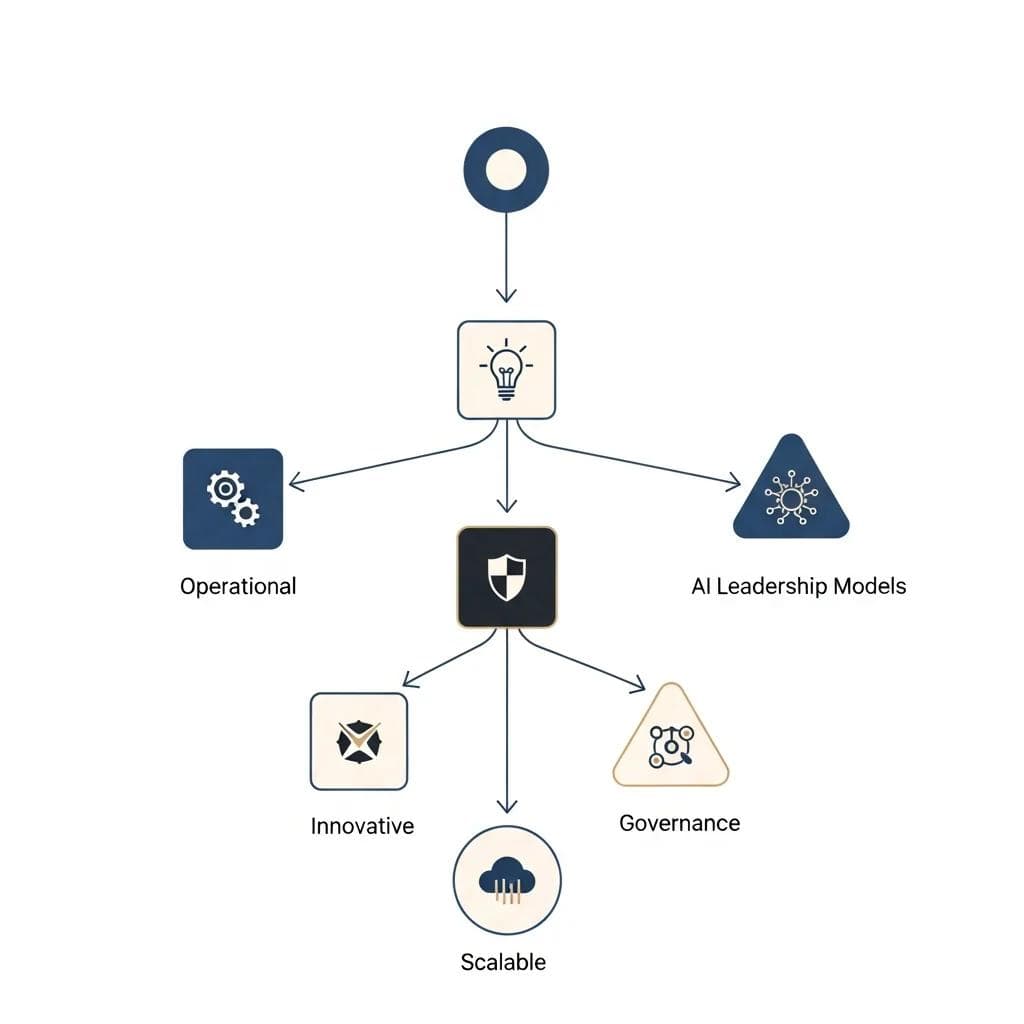
A decision tree flowchart for AI leadership model selection.
Choosing the Right Model: Decision Framework
Selecting the optimal AI leadership model requires careful evaluation of organizational factors, strategic objectives, and resource constraints. This framework provides a structured approach to making this critical decision.
Organizational Readiness Assessment
AI leadership model selection should begin with honest assessment of organizational AI maturity, technical capabilities, and change readiness. Organizations at different maturity stages require different leadership approaches to maximize success probability.
Key assessment dimensions include:
Technical Foundation: Evaluate existing data infrastructure, analytics capabilities, and technical talent. Organizations with strong technical foundations can support more sophisticated leadership models.
Cultural Readiness: Assess organizational openness to change, collaboration across departments, and leadership support for AI initiatives. Cultural barriers may require different leadership approaches.
Resource Availability: Consider budget constraints, talent acquisition capabilities, and time horizons for AI implementation. Resource limitations may favor certain models over others.
Strategic Importance: Determine whether AI represents a core competitive differentiator or supporting capability. Strategic importance influences the appropriate level of leadership investment.
Size and Scale Considerations
Organizational size significantly influences optimal AI leadership model selection, with different approaches working better at different scales.
Small Organizations (< 500 employees): Fractional or advisory models typically provide the best value, offering expert guidance without overwhelming overhead. Internal champions work well if technical talent exists.
Medium Organizations (500-5,000 employees): Centralized teams or strong champion networks provide optimal balance of expertise and cost. CAIO consideration begins at the upper end of this range.
Large Organizations (> 5,000 employees): CAIO or hybrid models combining centralized teams with business unit champions typically work best. Scale justifies dedicated executive leadership.
Multi-Business Organizations: Complex organizations usually require CAIO leadership to coordinate across diverse business units while maintaining strategic alignment.
Industry and Regulatory Factors
Regulatory requirements and industry dynamics influence AI leadership model selection, with some sectors requiring more sophisticated governance structures.
Highly Regulated Industries: Healthcare, finance, and government sectors typically require centralized governance and executive accountability, favoring CAIO or strong centralized team models.
Fast-Moving Industries: Technology and retail sectors may prioritize speed and innovation, making champion or fractional models attractive for rapid experimentation.
Traditional Industries: Manufacturing and services sectors often benefit from centralized expertise to bridge knowledge gaps and establish AI capabilities systematically.
Decision Matrix and Scoring
Organizations can use this scoring framework to evaluate model fit:
Score each factor 1-5 (5 = highest need/capability):
- Organizational size and complexity
- AI strategic importance
- Technical capability/talent
- Budget availability
- Speed requirements
- Risk tolerance
- Change management capability
Model Recommendations:
- Total Score 25-35: Consider fractional/advisory models
- Total Score 20-30: Evaluate champion or centralized team approaches
- Total Score 30-35: CAIO model likely appropriate
- Complex/Multi-dimensional: Hybrid approaches combining multiple models
A decision tree flowchart for AI leadership model selection.
Real-World Case Studies: Leadership Models in Action
Examining how successful organizations have implemented different AI leadership models provides practical insights for decision-making and implementation planning.
Case Study 1: Coca-Cola's Centralized AI Excellence
Coca-Cola implemented a centralized AI Center of Excellence that reduced customer support response time by 40% while maintaining consistent quality standards across global operations. The company established a dedicated AI team that serves multiple business units while maintaining unified governance and technical standards.
The centralized approach enabled Coca-Cola to:
- Standardize AI tools and platforms across regions
- Share successful AI models between business units
- Maintain consistent data quality and security standards
- Achieve economies of scale in AI infrastructure investments
Key success factors included strong executive sponsorship, clear service level agreements with business units, and regular communication about AI capabilities and limitations.
Case Study 2: Sanofi's Fractional Leadership Success
Sanofi utilized fractional AI leadership during their initial generative AI implementation, achieving significant operational improvements while building internal capabilities. According to MIT Sloan Management Review, Sanofi's approach focused on experimentation and risk management while developing long-term AI strategy.
The fractional model provided:
- Access to pharmaceutical industry AI expertise
- Flexible engagement based on project needs
- Cost-effective leadership during capability building
- External perspective on AI opportunities and risks
Sanofi's success demonstrates how fractional leadership can accelerate AI adoption while organizations build internal expertise and determine long-term leadership needs.
Case Study 3: Finance Firm's Champion Network
A mid-size finance firm implemented an AI champion network that automated 85% of customer calls, reducing operational costs by 46% while improving customer satisfaction. Internal champions across different departments coordinated through monthly meetings and shared resources.
Champion network advantages included:
- Deep understanding of business unit requirements
- Rapid prototyping and testing of AI solutions
- Strong user adoption through trusted internal advocates
- Cost-effective scaling of AI capabilities
The firm supplemented champions with external advisory support for strategic guidance and technical validation of complex initiatives.
Case Study 4: Technology Company CAIO Implementation
A large technology company appointed a Chief AI Officer to coordinate AI initiatives across multiple product lines and geographical regions. The CAIO established enterprise-wide AI governance while enabling business unit innovation.
The CAIO model enabled the company to achieve strategic AI alignment while maintaining innovation speed, resulting in 25% faster time-to-market for AI-enhanced products. Key success factors included:
- Clear mandate from CEO and board for AI transformation
- Authority to establish AI standards across business units
- Budget allocation for enterprise AI infrastructure
- Regular reporting on AI initiative performance and ROI
The CAIO also established AI ethics guidelines and risk management frameworks that became competitive differentiators in regulated markets.

Infographic_case_study.
Implementation Best Practices
Successful AI leadership model implementation requires careful planning, stakeholder alignment, and systematic execution. These best practices help organizations avoid common pitfalls and accelerate success.
Establishing Clear Governance
Effective AI governance provides the foundation for successful leadership model implementation, regardless of the specific approach chosen. Governance structures should address decision-making authority, resource allocation, risk management, and performance measurement.
Key governance elements include:
Decision Rights: Clearly define who makes strategic AI decisions, approves budgets, and resolves conflicts between business units. Ambiguous decision rights create delays and political conflicts.
Resource Allocation: Establish transparent processes for prioritizing AI projects, allocating budgets, and sharing technical resources. Fair resource allocation builds support for centralized leadership approaches.
Risk Management: Define acceptable risk levels, approval processes for high-risk projects, and escalation procedures for AI failures. Proactive risk management builds confidence in AI initiatives.
Performance Standards: Set clear expectations for AI project outcomes, timeline adherence, and quality standards. Consistent performance measurement enables continuous improvement.
Building AI Literacy Across Leadership
Organizational AI success requires broad leadership understanding of AI capabilities, limitations, and strategic implications. Even organizations with dedicated AI leadership must build AI literacy across the executive team and middle management.
AI literacy development should include:
Executive Education: Regular briefings on AI trends, competitive implications, and strategic opportunities. Executives need sufficient understanding to make informed resource allocation decisions.
Technical Awareness: Basic understanding of AI capabilities and limitations to set realistic expectations and identify appropriate use cases.
Risk Understanding: Awareness of AI risks including bias, privacy, security, and regulatory compliance to support informed decision-making.
Change Management: Skills in leading AI-driven organizational transformation and addressing employee concerns about AI adoption.
Talent Development and Retention
AI leadership success depends heavily on attracting, developing, and retaining specialized talent in a highly competitive market. Organizations must create compelling value propositions for AI professionals while building internal capabilities.
Talent strategy components include:
Competitive Compensation: AI professionals command premium salaries, requiring competitive compensation packages and career advancement opportunities.
Learning and Development: Continuous learning opportunities including conferences, training programs, and collaboration with academic institutions. AI professionals value organizations that invest in their growth.
Meaningful Work: Opportunities to work on challenging problems with business impact. AI professionals prefer roles where they can apply cutting-edge techniques to real business challenges.
Collaborative Culture: Environments that encourage experimentation, cross-functional collaboration, and knowledge sharing. Toxic or overly bureaucratic cultures struggle to retain top AI talent.
Measuring Success and ROI
Systematic measurement of AI initiative performance enables continuous improvement and demonstrates value to organizational stakeholders. Measurement frameworks should capture both technical performance and business impact.
Key performance indicators include:
Technical Metrics: Model accuracy, processing speed, system uptime, and data quality measures. Technical performance provides foundation for business value creation.
Business Impact: Revenue growth, cost reduction, customer satisfaction improvement, and operational efficiency gains. Business metrics demonstrate AI's contribution to organizational objectives.
Adoption Metrics: User engagement, process automation rates, and employee satisfaction with AI tools. Adoption measures indicate successful change management and user acceptance.
Innovation Indicators: Number of new AI use cases, time-to-deployment for new models, and successful scaling of pilot projects. Innovation metrics show organizational AI maturity growth.
Dashboard_metrics.
Common Pitfalls and How to Avoid Them
Organizations implementing AI leadership models face predictable challenges that can derail even well-planned initiatives. Understanding these pitfalls and their solutions improves implementation success rates.
Pitfall 1: Unrealistic Expectations
Many organizations expect immediate transformation from AI leadership appointments without addressing underlying infrastructure, data quality, or process issues. This expectation mismatch leads to disappointment and reduced support for AI initiatives.
Prevention strategies include:
- Set realistic timelines for AI capability development (typically 12-24 months for significant impact)
- Communicate clearly about required investments in data infrastructure and process changes
- Start with pilot projects that demonstrate value before scaling to enterprise-wide initiatives
- Educate stakeholders about AI limitations and implementation challenges
Pitfall 2: Insufficient Resource Allocation
Organizations often underestimate the resources required for successful AI implementation, leading to underfunded initiatives that fail to deliver promised results. AI requires investments in technology, talent, data infrastructure, and change management.
Resource planning should include:
- Technology infrastructure including cloud computing, data storage, and AI development platforms
- Specialized talent acquisition and retention costs
- Data cleansing and preparation efforts (often 60-80% of project time)
- Change management and training programs for affected employees
- Ongoing monitoring and maintenance of AI systems
Pitfall 3: Neglecting Change Management
Technical AI success doesn't automatically translate to business value without effective change management and user adoption. Many organizations focus heavily on technical implementation while underestimating human factors.
Change management best practices include:
- Involve affected employees in AI initiative planning and design
- Provide comprehensive training on new AI-enhanced processes
- Address job security concerns and communicate career development opportunities
- Celebrate early wins and share success stories across the organization
- Establish feedback mechanisms for continuous improvement
Pitfall 4: Inadequate Data Foundation
AI initiatives fail when built on poor data quality, inconsistent data formats, or inadequate data governance. Organizations must address data foundation issues before expecting AI success.
Data preparation requirements include:
- Data quality assessment and cleansing across relevant systems
- Standardization of data formats and definitions
- Implementation of data governance policies and procedures
- Investment in data integration and management tools
- Establishment of data quality monitoring and maintenance processes

Warning_signs.
Future Trends in AI Leadership
AI leadership models continue evolving as organizations gain experience and AI technology advances. Understanding emerging trends helps organizations prepare for future leadership needs and opportunities.
Emerging Role Specializations
AI leadership is becoming more specialized as organizations recognize the need for distinct expertise in different aspects of AI implementation and management. New roles emerging include:
AI Ethics Officers: Specialists focused on responsible AI development, bias detection, and regulatory compliance. These roles become critical as AI regulation increases and ethical concerns gain prominence.
AI Product Managers: Leaders who translate AI capabilities into product features and customer value. These roles bridge technical AI teams and product development organizations.
AI Operations Managers: Specialists in deploying, monitoring, and maintaining AI systems in production environments. These roles focus on AI reliability and performance optimization.
AI Training and Development Leaders: Experts in building organizational AI literacy and managing AI-related workforce transformation.
Hybrid Leadership Models
Organizations increasingly adopt hybrid approaches that combine elements from multiple leadership models to address specific needs and constraints. Common hybrid patterns include:
CAIO with Business Unit Champions: Executive leadership combined with embedded champions who drive adoption within specific business areas.
Centralized Services with Fractional Expertise: Internal AI teams supplemented by external advisors for specialized knowledge or strategic guidance.
Rotational Leadership: Temporary assignments where experienced AI leaders help establish capabilities before transitioning to permanent internal leadership.
AI Leadership Automation
Paradoxically, AI itself is beginning to support AI leadership through automated monitoring, performance optimization, and decision support tools. These developments include:
Automated AI Governance: Systems that monitor AI model performance, detect drift, and recommend interventions without human oversight.
AI Strategy Optimization: Tools that analyze AI project performance and recommend resource allocation and prioritization decisions.
Predictive AI Planning: Systems that forecast AI technology trends and recommend strategic investments based on organizational goals and capabilities.
Regulatory and Compliance Evolution
Increasing AI regulation will require more sophisticated governance structures and specialized compliance expertise within AI leadership teams. Organizations must prepare for:
Enhanced Documentation Requirements: Detailed records of AI development processes, decision logic, and performance monitoring.
Audit and Inspection Capabilities: Systems and processes to support regulatory audits of AI systems and their business impact.
Cross-Border Compliance: Coordination of AI governance across different regulatory jurisdictions as organizations operate globally.

Future_timeline.
Frequently Asked Questions
What qualifications should a Chief AI Officer have?
A Chief AI Officer should combine deep technical AI knowledge with proven business leadership experience, typically requiring an advanced degree in computer science, data science, or related field, plus 10+ years of leadership experience in technology or AI-driven organizations. Essential qualifications include understanding of machine learning algorithms, data architecture, AI ethics, and regulatory compliance. Business qualifications include strategic planning, change management, budget management, and stakeholder communication skills. Many successful CAIOs have experience in consulting, product management, or technical leadership roles at technology companies.
How much should organizations budget for AI leadership?
AI leadership costs typically range from $200,000-$500,000 annually for fractional models to $800,000-$1,500,000+ for full-time CAIO roles including compensation, benefits, and supporting resources. Organizations should budget additional resources for AI team members, technology infrastructure, and external consulting support. As a general guideline, AI leadership costs should represent 10-15% of total AI initiative budgets. Smaller organizations might allocate $50,000-$150,000 annually for fractional leadership, while large enterprises may invest $2-5 million in comprehensive AI leadership structures.
When should organizations transition between leadership models?
Organizations should consider transitioning AI leadership models when current approaches no longer support growth, create bottlenecks, or fail to deliver expected business value. Common transition triggers include scaling beyond 50-100 AI use cases, expanding AI initiatives across multiple business units, facing significant regulatory requirements, or experiencing coordination challenges between AI projects. Organizations typically start with champion or fractional models and transition to centralized or CAIO approaches as AI becomes more strategic. Transitions should be planned 6-12 months in advance to ensure continuity and stakeholder alignment.
How do you measure AI leadership effectiveness?
AI leadership effectiveness should be measured through both technical performance metrics and business impact indicators, including project delivery rates, business value creation, stakeholder satisfaction, and organizational AI maturity advancement. Key metrics include percentage of AI projects delivered on time and budget, average time from concept to production deployment, business ROI from AI initiatives, employee adoption rates of AI tools, and advancement in organizational AI capability assessments. Effective AI leaders also demonstrate progress in risk management, regulatory compliance, and talent development. Measurement frameworks should balance short-term project success with long-term strategic capability building.
What are the biggest risks of not having dedicated AI leadership?
Organizations without dedicated AI leadership face significant risks including fragmented AI initiatives, inconsistent quality standards, regulatory compliance failures, and missed competitive opportunities that can cost millions in lost revenue and remediation efforts. Specific risks include duplicated development efforts across departments, security vulnerabilities from inconsistent AI governance, bias and ethical issues from inadequate oversight, and inability to scale successful AI pilots. Organizations may also experience talent retention challenges, vendor management issues, and strategic misalignment between AI investments and business objectives. These risks compound over time, making later remediation more expensive and disruptive.
How do you build buy-in for AI leadership investment?
Building buy-in for AI leadership investment requires demonstrating clear business value through pilot projects, competitive analysis, and risk assessment that shows the cost of inaction exceeding investment costs. Effective approaches include showcasing successful AI implementations from similar organizations, quantifying current inefficiencies that AI leadership could address, and presenting competitive threats from organizations with stronger AI capabilities. Business cases should include specific ROI projections, risk mitigation benefits, and strategic advantages from coordinated AI initiatives. Stakeholder education about AI trends and implications helps build understanding of leadership investment necessity.
Can small organizations benefit from AI leadership models?
Small organizations can absolutely benefit from AI leadership models, particularly fractional and advisory approaches that provide expert guidance without full-time executive overhead costs. Small organizations often achieve faster AI adoption through focused leadership because they have fewer bureaucratic barriers and can implement changes more quickly. Fractional AI leaders can provide strategic guidance, help avoid common mistakes, and accelerate capability development for 20-30% of full-time executive costs. Small organizations should focus on leadership models that provide maximum expertise and guidance while maintaining cost efficiency and operational flexibility.
What's the difference between AI leadership and data leadership?
AI leadership focuses specifically on artificial intelligence strategy, implementation, and governance, while data leadership encompasses broader data management, analytics, and infrastructure responsibilities across the organization. AI leaders concentrate on machine learning models, AI ethics, algorithm development, and AI-driven business transformation. Data leaders focus on data quality, data governance, analytics infrastructure, and enterprise data strategy. Many organizations need both roles, with data leaders providing foundation capabilities that AI leaders build upon. In smaller organizations, these responsibilities might be combined, but larger organizations typically require specialized expertise in each area.
How do AI leadership models differ across industries?
AI leadership models vary significantly across industries based on regulatory requirements, competitive dynamics, technical complexity, and risk tolerance, with highly regulated industries typically requiring more centralized governance structures. Healthcare and financial services organizations often need CAIO-level leadership due to regulatory compliance requirements and risk management needs. Technology companies may favor champion networks or fractional models that enable rapid innovation and experimentation. Manufacturing organizations typically benefit from centralized expertise to bridge traditional operations with AI capabilities. Retail and consumer goods companies often use hybrid models that combine centralized strategy with business unit execution flexibility.
What happens when AI leadership initiatives fail?
When AI leadership initiatives fail, organizations should conduct thorough post-mortems to identify root causes, preserve valuable lessons learned, and develop improved approaches rather than abandoning AI leadership entirely. Common failure causes include unrealistic expectations, insufficient resource allocation, poor stakeholder alignment, or inadequate technical foundation. Recovery strategies include reassessing organizational readiness, adjusting leadership model selection, improving change management processes, and rebuilding stakeholder confidence through smaller, more achievable initiatives. Organizations should view initial failures as learning opportunities that inform more successful future approaches rather than evidence that AI leadership is unnecessary.
Conclusion: Making the Right Choice for Your Organization
The question isn't whether your organization needs AI leadership—it's which model best fits your current situation and strategic objectives. AI needs ownership to succeed, and the right leadership model depends on your scale, ambition, and readiness—not on trends or what competitors are doing.
Organizations that treat AI as a strategic imperative require dedicated leadership structures to coordinate initiatives, manage risks, and deliver business value. The choice between internal champions, centralized teams, Chief AI Officer roles, or fractional leadership depends on specific organizational factors including size, technical maturity, resource availability, and strategic importance of AI.
The most successful organizations start with realistic assessment of their AI readiness and choose leadership models that match their current capabilities while providing growth paths for increasing AI sophistication. Small organizations might begin with fractional leadership or champion networks, while large enterprises may require dedicated CAIO roles from the start.
Key decision factors include:
- Organizational size and complexity
- AI strategic importance and competitive necessity
- Available resources and technical capabilities
- Risk tolerance and regulatory requirements
- Speed requirements and cultural readiness for change
Remember that AI leadership models can evolve as organizations mature and requirements change. The goal is choosing an approach that provides appropriate expertise, accountability, and coordination for your current needs while enabling future growth and adaptation.
Success in AI leadership comes not from following trends but from honest assessment of organizational needs and systematic implementation of appropriate leadership structures. Organizations that invest thoughtfully in AI leadership—whether through internal development, external expertise, or hybrid approaches—position themselves to capture AI's transformative potential while managing its inherent risks and challenges.
The AI revolution requires leadership. The question is what form that leadership should take for your organization's unique situation and strategic objectives.

Strategic_roadmap.
Community
Join the conversation
More Blog Posts

The Future of AI: Skynet or The Jetsons?
Explore the balance between AI's potential and risks by understanding AI governance, which ensures ethical development and responsible integration in business practices.

AI Agents: The Next Generation of Business Software Transforming Operations
Discover how AI agents are revolutionizing business operations by transforming software into proactive collaborators that anticipate needs and streamline complex processes autonomously.

AI Agents in Enterprise Workflows: Transforming Business Operations for 2026
Discover how AI agents are revolutionizing enterprise workflows, transforming businesses into proactive, autonomous entities that enhance efficiency and drive measurable value.