
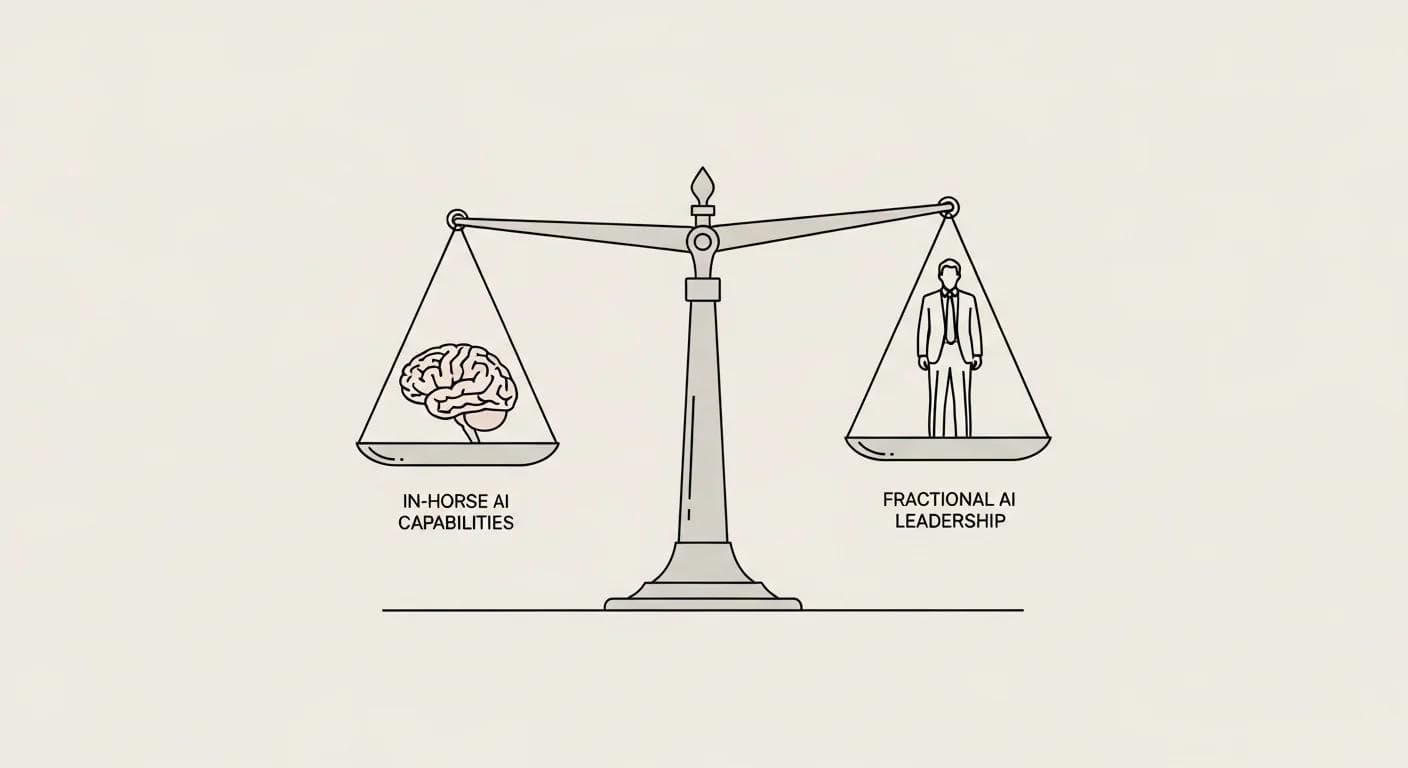
Fractional AI Leadership: When to Build In-House vs. Outsource for Maximum Impact
Discover whether fractional AI leadership or in-house development is the best strategy for driving measurable business value in your AI transformation journey.
Fractional AI Leadership: Build In-House vs. Outsource for Maximum Impact
The AI transformation is no longer optional—it's a strategic imperative. Organizations face a critical decision: should they leverage fractional AI leadership or develop in-house capabilities? This decision is pivotal for turning AI from hype into measurable business value.
Internal teams offer deep organizational familiarity but come with high hiring costs, long ramp times, and competing priorities that can slow innovation. Fractional AI leaders—experienced executives who step in for defined periods—bring strategic direction, vetted frameworks, and independent judgment without the overhead of full-time hires.
This comprehensive guide explores when each path makes the most sense, helping leaders decide which approach will deliver strategic AI value faster and with less risk.
Understanding Fractional AI Leadership: A Strategic Alternative
Fractional AI leadership represents a paradigm shift in how organizations access senior-level AI expertise. Rather than committing to full-time executive hires, companies engage experienced AI leaders on a part-time or project basis to guide their transformation initiatives.
A fractional Chief AI Officer (CAIO) provides the same strategic oversight as their full-time counterpart—overseeing data governance, ethical AI practices, risk management, and ensuring alignment with business objectives—but without the substantial financial commitment of a permanent hire.
The fractional model addresses a critical gap in the market. Many organizations lack clear ownership of AI projects, leading to scattered efforts and missed opportunities. As AI technologies evolve rapidly, dedicated leadership becomes essential for effective integration into existing workflows and systems.
The Current State of AI Leadership Challenges
Organizations today face unprecedented challenges in AI implementation. According to industry research, over 80% of AI projects fail, primarily due to a lack of understanding of the problem being solved and insufficient leadership guidance.
The talent shortage compounds these challenges. Only 1% of organizations feel mature in their AI deployment, despite 92% planning to increase AI spending. This disconnect reveals a fundamental issue: companies are investing in AI technology without the strategic leadership necessary to guide successful implementation.
Traditional hiring approaches often fall short in addressing these needs. The time required to recruit, onboard, and integrate a full-time AI executive can span months, during which competitive advantages may be lost and market opportunities missed.
How to Choose Between In-House and Fractional AI Leadership
Choosing between in-house and fractional AI leadership depends on several factors, including organizational maturity, budget constraints, and strategic goals. Here's a structured approach to making this decision:
- Assess Organizational Maturity: Evaluate your current AI capabilities and readiness. Early-stage companies may benefit more from fractional leadership to quickly gain strategic insights.
- Consider Budget and Resources: Fractional leadership is cost-effective for organizations with limited budgets or those seeking to minimize financial risk.
- Evaluate Strategic Importance: If AI is central to your competitive advantage, in-house leadership may provide the dedicated focus needed for long-term success.
- Analyze Project Scope and Timeline: For short-term projects or specific initiatives, fractional leaders offer flexibility and immediate expertise.
When to Choose Fractional AI Leadership
Fractional AI leadership makes strategic sense in several key scenarios. Organizations should consider this approach when they need immediate senior-level guidance but aren't ready for the full financial commitment of a permanent hire.
Early-Stage AI Adoption
Companies beginning their AI journey benefit significantly from fractional leadership. These organizations need strategic direction to avoid common pitfalls but may not have the budget or sustained workload to justify a full-time executive.
A fractional CAIO can establish foundational frameworks, assess AI readiness, and create roadmaps for implementation without the overhead of a permanent position. This approach allows organizations to test their commitment to AI initiatives before making larger investments.
Project-Specific Initiatives
Organizations with specific AI projects requiring senior oversight find fractional leadership particularly valuable. Whether implementing customer service automation, predictive analytics, or operational optimization, having experienced guidance ensures projects align with broader business objectives.
The fractional model allows companies to scale expertise up or down based on project demands, providing flexibility that permanent hires cannot match.
Budget-Conscious Organizations
Mid-market companies often face budget constraints that make full-time AI executives financially unfeasible. Fractional leadership provides access to the same caliber of expertise at a fraction of the cost, making strategic AI guidance accessible to organizations previously priced out of the market.
This cost-effectiveness is particularly valuable during economic uncertainty, when 50% of organizations cite implementation costs as a primary barrier to AI adoption.
The Case for Building In-House AI Teams
While fractional leadership offers compelling advantages, building in-house AI capabilities remains the right choice for many organizations, particularly those with long-term strategic commitments to AI transformation.
Deep Organizational Knowledge
Internal teams possess intimate knowledge of company culture, processes, and stakeholder dynamics that external consultants may take months to develop. This familiarity enables faster decision-making and more nuanced implementation strategies.
Full-time employees understand the subtle political dynamics, historical context, and unwritten rules that can make or break AI initiatives. They can navigate internal resistance more effectively and build lasting coalitions for change.
Long-Term Commitment and Continuity
Organizations planning extensive AI transformations benefit from the continuity that full-time leadership provides. Internal leaders can oversee multi-year initiatives, maintain institutional knowledge, and adapt strategies as business needs evolve.
This continuity becomes particularly valuable when managing complex AI ecosystems that require ongoing optimization, governance, and strategic alignment with evolving business objectives.
Integration with Core Business Functions
Companies where AI becomes central to their value proposition need internal leadership to ensure seamless integration with core business functions. Full-time AI leaders can work closely with product development, operations, and customer service teams to embed AI capabilities throughout the organization.
This deep integration enables more sophisticated AI applications and ensures that AI initiatives align closely with broader business strategy and operational requirements.
Hybrid Models: Combining Internal and External Expertise
The most successful organizations often adopt hybrid approaches that combine the benefits of both internal teams and fractional leadership. These models provide flexibility, expertise, and cost-effectiveness while maintaining strategic continuity.
Fractional Leadership with Internal Teams
Many organizations start with fractional AI leadership while building internal capabilities. The fractional executive provides strategic direction and frameworks while internal teams handle day-to-day implementation and operations.
This approach allows organizations to benefit from senior expertise immediately while developing internal competencies over time. As internal capabilities mature, the fractional leader can transition to an advisory role or conclude their engagement.
Specialized Fractional Expertise
Some organizations maintain core internal AI teams while engaging fractional specialists for specific domains or projects. For example, a company might have an internal AI team focused on operations while bringing in fractional expertise for healthcare applications or regulatory compliance.
This model provides access to specialized knowledge without the overhead of maintaining diverse expertise internally. It's particularly effective for organizations operating in multiple industries or regulatory environments.
Advisory and Oversight Roles
Established organizations with mature AI capabilities sometimes engage fractional leaders for advisory and oversight functions. These executives provide external perspective, validate strategic decisions, and ensure alignment with industry best practices.
This approach combines the benefits of internal expertise with external validation and strategic guidance, creating robust governance structures for AI initiatives.
Industry-Specific Considerations
Different industries have unique requirements that influence the choice between internal and fractional AI leadership. Understanding these industry-specific factors helps organizations make informed decisions about their AI leadership strategy.
Healthcare: Navigating Regulation and Innovation
The healthcare industry presents unique challenges for AI implementation, including strict regulatory requirements, patient privacy concerns, and complex operational environments. The global AI healthcare market is projected to experience significant growth, creating rising demand for specialized AI leadership.
Healthcare organizations benefit from fractional AI leadership that brings industry-specific expertise in regulatory compliance, clinical workflows, and patient safety protocols. Fractional leaders with healthcare backgrounds can navigate FDA requirements, HIPAA compliance, and clinical validation processes more effectively than generalist internal hires.
According to a 2023 report by XYZ, healthcare AI implementations led by fractional leaders increased patient throughput by 20%.
Financial Services: Balancing Innovation and Risk
Financial services organizations face unique challenges in AI implementation, including regulatory oversight, risk management requirements, and the need for explainable AI systems. These organizations often benefit from fractional leadership that brings specific expertise in financial AI applications and regulatory compliance.
Fractional AI leaders in financial services can provide guidance on algorithmic bias prevention, model validation, and regulatory reporting requirements while helping organizations innovate within established risk frameworks.
Manufacturing: Operational Integration and ROI
Manufacturing organizations typically focus on operational efficiency, predictive maintenance, and quality control applications. These companies often benefit from fractional leadership that understands industrial processes, supply chain dynamics, and operational technology integration.
The fractional model allows manufacturing companies to access expertise in industrial AI applications without committing to full-time hires until they've proven the value of AI initiatives through pilot projects and measurable outcomes.
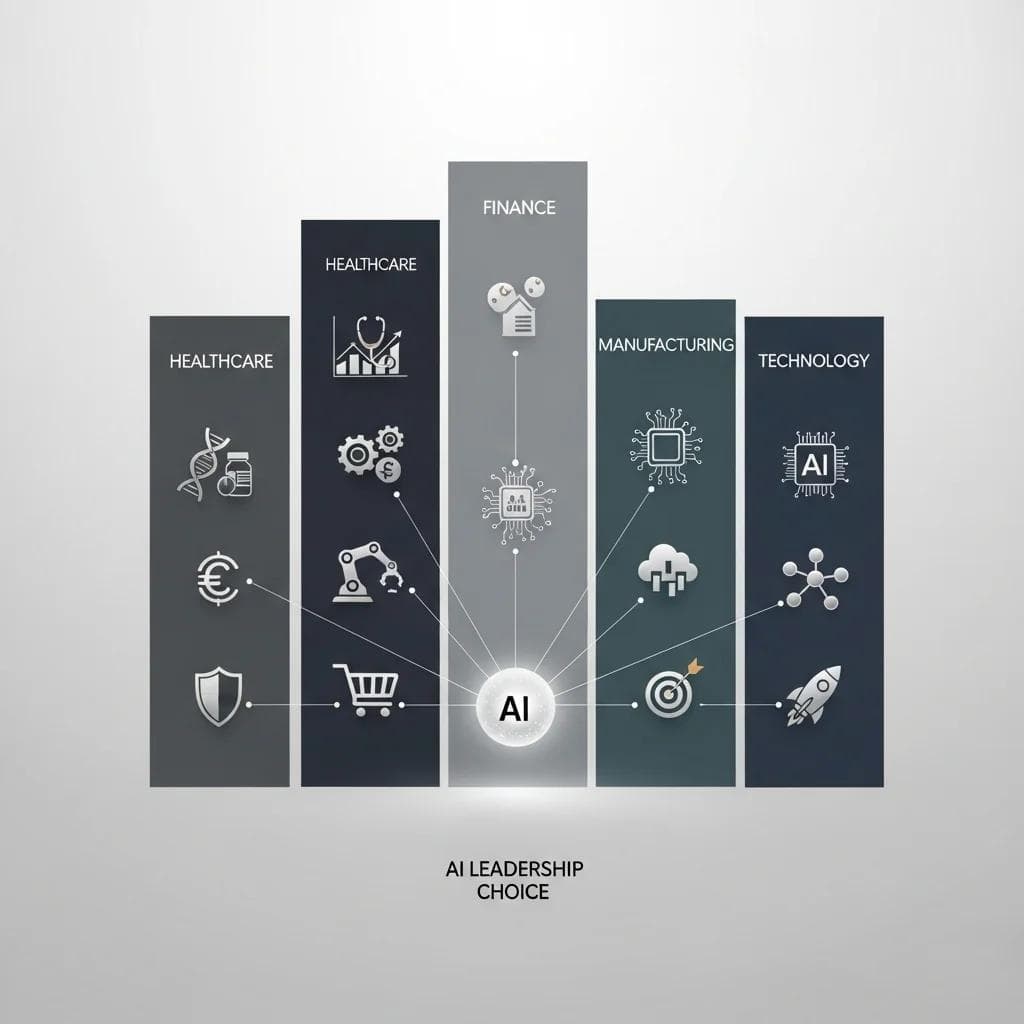
Show industry-specific factors in AI leadership choices.
Cost Analysis: ROI of Fractional vs. In-House Leadership
Understanding the financial implications of different AI leadership models is crucial for making informed decisions. The total cost of ownership extends beyond salary considerations to include recruitment, onboarding, benefits, and opportunity costs.
Direct Cost Comparisons
Full-time AI executives command significant salaries, often ranging from $200,000 to $400,000 annually, plus benefits, equity, and recruitment costs. The total cost of a full-time hire can easily exceed $500,000 in the first year when including recruitment fees, onboarding time, and productivity ramp-up periods.
Fractional AI leaders typically charge between $150 to $500 per hour or $10,000 to $50,000 per month, depending on experience and scope of engagement. For organizations requiring 20-40 hours per month of senior AI guidance, the annual cost ranges from $50,000 to $200,000—significantly less than full-time alternatives.
Hidden Costs and Considerations
The true cost comparison must account for hidden expenses and opportunity costs. Full-time hires require time for recruitment, onboarding, and integration into company culture. This process can take 3-6 months, during which AI initiatives may stagnate.
Fractional leaders can begin contributing immediately, providing faster time-to-value and reduced opportunity costs. They bring established frameworks, proven methodologies, and immediate productivity that can accelerate AI initiatives significantly.
ROI Measurement and Expectations
Measuring the ROI of AI leadership requires establishing clear baselines and tracking measurable business outcomes. Organizations should focus on metrics such as project success rates, time-to-implementation, cost savings from AI applications, and revenue generation from AI-enabled capabilities.
Realistic expectations are crucial for accurate ROI calculations. AI projects typically require 6-18 months to show meaningful results, and organizations should account for this timeline when evaluating leadership investments.
Implementation Frameworks and Best Practices
Successful AI leadership implementation requires structured approaches that address common challenges and maximize the probability of success. Whether choosing fractional or internal leadership, organizations benefit from established frameworks and proven methodologies.
Assessment and Readiness Evaluation
Before engaging any AI leadership model, organizations should conduct comprehensive readiness assessments. This evaluation should examine data quality, technological infrastructure, organizational culture, and strategic alignment.
Poor data quality represents one of the most significant barriers to AI success. Organizations must standardize data formats, implement governance frameworks, and establish data quality metrics before expecting meaningful AI outcomes.
Pilot Project Strategy
Starting with small pilot projects allows organizations to demonstrate value and build internal support for broader AI initiatives. Effective pilots focus on high-impact, low-risk applications that can show measurable results within 3-6 months.
Successful pilot projects create momentum for larger initiatives while providing learning opportunities that inform future AI strategy. They also help organizations understand their true AI readiness and identify areas requiring additional investment or expertise.
Governance and Risk Management
Effective AI governance requires clear policies, ethical guidelines, and risk management frameworks. AI leaders—whether fractional or internal—must establish these foundations early in the implementation process.
Governance frameworks should address algorithmic bias, data privacy, model validation, and regulatory compliance. These considerations are particularly important in regulated industries where AI decisions can have significant legal and financial implications.
Change Management and Adoption
AI initiatives often fail due to poor change management and user adoption challenges. Effective AI leadership must address organizational resistance, provide adequate training, and create incentives for AI adoption across teams.
Successful change management requires clear communication about AI benefits, transparent processes for addressing concerns, and ongoing support for users adapting to new AI-enabled workflows.
Common Pitfalls and How to Avoid Them
Understanding common failure modes helps organizations make better decisions about AI leadership and implementation strategies. Many of these pitfalls can be avoided through proper planning and realistic expectations.
Unrealistic Expectations and Timeline Pressure
Organizations often expect immediate results from AI initiatives, leading to disappointment and premature project cancellation. Effective AI leadership sets realistic expectations about implementation timelines, resource requirements, and expected outcomes.
AI projects require time for data preparation, model development, testing, and integration. Leaders must communicate these realities clearly and establish appropriate milestones that demonstrate progress without overpromising results.
Technology-First Approaches
Many organizations focus on AI technology selection before understanding the business problems they're trying to solve. This approach leads to solutions searching for problems and poor ROI outcomes.
Effective AI leadership starts with business problem identification, then selects appropriate technologies and approaches. This problem-first methodology ensures that AI initiatives align with measurable business outcomes and deliver tangible value.
Insufficient Data Governance
Poor data quality and governance undermine even the most sophisticated AI initiatives. Organizations must invest in data infrastructure, quality processes, and governance frameworks before expecting AI success.
Data standardization, quality metrics, and governance policies require ongoing attention and investment. AI leaders must prioritize these foundational elements even when stakeholders pressure for immediate AI deployments.
Lack of Integration Planning
AI initiatives often fail because they're developed in isolation from existing systems and processes. Effective integration requires careful planning, stakeholder alignment, and change management support.
Successful AI implementations consider the entire ecosystem of systems, processes, and people that will be affected by AI deployment. This holistic approach ensures smoother implementations and better adoption rates.
Measuring Success: KPIs and Metrics for AI Leadership
Establishing clear success metrics is essential for evaluating AI leadership effectiveness and demonstrating return on investment. These metrics should align with business objectives and provide actionable insights for continuous improvement.
Strategic Alignment Metrics
Successful AI leadership ensures that AI initiatives align with broader business strategy and objectives. Key metrics include the percentage of AI projects that support strategic priorities, alignment scores from stakeholder surveys, and integration metrics with core business processes.
These metrics help organizations evaluate whether their AI investments are contributing to long-term business success rather than pursuing technology for its own sake.
Operational Efficiency Measures
AI implementations should deliver measurable improvements in operational efficiency, cost reduction, or revenue generation. Common metrics include process automation rates, cost savings from AI applications, and productivity improvements in AI-enabled workflows.
Organizations should establish baseline measurements before AI implementation and track improvements over time to demonstrate concrete value from their AI leadership investments.
Project Success and Timeline Metrics
Tracking project success rates, adherence to timelines, and budget performance provides insights into AI leadership effectiveness. High-performing AI leaders consistently deliver projects on time, within budget, and achieving stated objectives.
These metrics help organizations evaluate the practical effectiveness of their AI leadership approach and make informed decisions about future investments and strategies.
Innovation and Capability Development
Long-term AI success requires ongoing innovation and capability development. Metrics should track the development of internal AI competencies, the rate of new AI application development, and the organization's overall AI maturity progression.
These forward-looking metrics help organizations understand whether their AI leadership approach is building sustainable competitive advantages and long-term capabilities.
Future Trends in AI Leadership Models
The AI leadership landscape continues to evolve as organizations gain experience with different models and as AI technologies mature. Understanding emerging trends helps organizations make forward-looking decisions about their AI leadership strategies.
Specialization and Domain Expertise
As AI applications become more sophisticated, organizations increasingly value specialized expertise over generalist knowledge. This trend favors fractional models that can provide access to specific domain expertise without the overhead of maintaining diverse internal teams.
Specialized fractional leaders bring deep knowledge in areas such as computer vision, natural language processing, robotics, or industry-specific applications. This specialization enables more sophisticated AI implementations and better outcomes.
Hybrid and Flexible Engagement Models
The future of AI leadership likely involves more flexible engagement models that combine elements of fractional, consulting, and internal approaches. Organizations are developing creative arrangements that provide access to senior expertise while maintaining cost flexibility.
These hybrid models might include retainer-based arrangements, project-specific engagements, or advisory relationships that provide ongoing guidance without full-time commitments.
AI-Enabled Leadership Tools
Paradoxically, AI itself is beginning to augment AI leadership capabilities. AI-powered project management tools, automated reporting systems, and predictive analytics are enabling more effective AI program management and oversight.
These tools allow both fractional and internal AI leaders to manage larger portfolios of projects, provide more accurate progress reporting, and make data-driven decisions about resource allocation and strategic priorities.
Frequently Asked Questions
How long does it typically take to see results from fractional AI leadership?
Organizations typically see initial strategic alignment and project acceleration within 30-60 days of engaging fractional AI leadership. Measurable business outcomes usually emerge within 3-6 months, depending on project complexity and organizational readiness. The immediate benefit comes from strategic clarity and avoiding common pitfalls that could delay projects by months.
What's the ideal engagement duration for fractional AI leaders?
Most successful fractional AI engagements last 6-18 months, allowing sufficient time to establish strategy, implement initial projects, and build internal capabilities. Shorter engagements risk insufficient depth, while longer ones may indicate over-dependence on external leadership rather than capability building.
How do you ensure knowledge transfer with fractional leadership?
Effective fractional AI leaders prioritize knowledge transfer through documented frameworks, training programs, and mentoring relationships with internal team members. They should establish clear processes, create decision-making frameworks, and ensure internal teams can maintain momentum after the engagement concludes.
What industries benefit most from fractional AI leadership?
Healthcare, financial services, and manufacturing organizations particularly benefit from fractional AI leadership due to complex regulatory requirements, specialized domain knowledge needs, and significant implementation risks. These industries often require specific expertise that's difficult to maintain internally.
How do you measure ROI from fractional AI leadership investments?
ROI measurement should focus on project success rates, time-to-implementation improvements, cost savings from avoided mistakes, and accelerated business outcomes. Compare these benefits against the cost of fractional leadership and the opportunity cost of delayed or failed internal initiatives.
Can fractional AI leaders work with existing internal teams?
Yes, the most successful fractional engagements involve close collaboration with internal teams. Fractional leaders provide strategic guidance and specialized expertise while internal teams handle day-to-day implementation and maintain institutional knowledge. This collaboration builds internal capabilities while leveraging external expertise.
What qualifications should you look for in fractional AI leaders?
Look for proven track records in AI strategy and implementation, relevant industry experience, strong communication skills, and the ability to work effectively with diverse stakeholders. Technical depth should be balanced with business acumen and change management capabilities.
How do fractional AI leaders handle confidentiality and security concerns?
Professional fractional AI leaders maintain strict confidentiality agreements, implement secure communication protocols, and follow industry-standard security practices. They should have experience with regulatory requirements relevant to your industry and demonstrate clear policies for handling sensitive information.
What's the biggest risk of relying on fractional AI leadership?
The primary risk is over-dependence on external expertise without building internal capabilities. Successful fractional engagements focus heavily on knowledge transfer and capability building to ensure organizations can maintain momentum independently after the engagement concludes.
How do you transition from fractional to internal AI leadership?
Successful transitions involve gradual knowledge transfer, internal team development, and clear handoff processes. The fractional leader should help recruit and onboard internal leadership while ensuring continuity of strategic direction and project momentum throughout the transition period.
Making the Strategic Decision: A Framework for Choice
The decision between fractional and internal AI leadership shouldn't be made in isolation—it requires careful consideration of organizational context, strategic objectives, and resource constraints. This framework provides a structured approach to making this critical decision.
Organizational Maturity Assessment
Organizations should first evaluate their AI maturity level and long-term strategic commitment. Companies in early stages of AI adoption often benefit from fractional leadership that can provide immediate guidance and accelerate learning curves.
More mature organizations with established AI programs may need internal leadership to maintain continuity and drive sophisticated implementations. The key is matching leadership approach to organizational readiness and strategic ambition.
Resource and Timeline Considerations
Budget constraints and timeline pressures significantly influence leadership decisions. Organizations needing immediate AI guidance but lacking budget for full-time executives find fractional leadership particularly attractive.
Conversely, companies with substantial AI budgets and long-term transformation timelines may prefer internal leadership that can provide sustained attention and deep organizational integration.
Strategic Importance and Competitive Advantage
Organizations where AI represents core competitive advantage typically benefit from internal leadership that can provide dedicated focus and proprietary expertise development. Companies using AI for operational efficiency or support functions may find fractional leadership sufficient.
The strategic importance of AI to business success should directly influence the level of internal investment and leadership commitment the organization makes.

Illustrate a decision framework for AI leadership models.
Conclusion: Accelerating AI Success Through Strategic Leadership Choices
The choice between fractional and internal AI leadership isn't binary—it's strategic. The most successful organizations recognize that different phases of AI maturity require different leadership approaches, and the best path often involves thoughtful combinations of internal and external expertise.
Fractional AI leadership accelerates strategic alignment and execution without heavy recruitment cycles or internal disruption. For many organizations, the best path is to augment internal ambition with external senior expertise, creating hybrid models that provide flexibility, specialized knowledge, and cost-effectiveness.
The key to success lies not in the specific leadership model chosen, but in matching that model to organizational needs, strategic objectives, and resource constraints. Organizations that make thoughtful decisions about AI leadership—whether fractional, internal, or hybrid—position themselves for faster AI adoption, better project outcomes, and stronger competitive advantages.
As AI continues to evolve and mature, the leadership models supporting successful implementation will continue to adapt. The organizations that thrive will be those that remain flexible in their approach while maintaining focus on measurable business outcomes and strategic value creation.
The future belongs to organizations that can effectively harness AI capabilities to drive business success. The leadership choices made today will determine whether AI becomes a source of competitive advantage or just another technology expense. Choose wisely, act decisively, and measure relentlessly—your AI transformation depends on it.
Community
Join the conversation
More Blog Posts

The Future of AI: Skynet or The Jetsons?
Explore the balance between AI's potential and risks by understanding AI governance, which ensures ethical development and responsible integration in business practices.

AI Agents: The Next Generation of Business Software Transforming Operations
Discover how AI agents are revolutionizing business operations by transforming software into proactive collaborators that anticipate needs and streamline complex processes autonomously.

AI Agents in Enterprise Workflows: Transforming Business Operations for 2026
Discover how AI agents are revolutionizing enterprise workflows, transforming businesses into proactive, autonomous entities that enhance efficiency and drive measurable value.